International Journal of Computational Intelligence Systems

Volume 12, Issue 2, 2019, Pages 706 - 712

T-Normed Fuzzy TM-Subalgebra of TM-Algebras

Authors
Julie Thomas*, K. Indhira, V. M. Chandrasekaran
Department of Mathematics, Vellore Institute of Technology, Vellore, Tamil Nadu, 632014, India
*Corresponding author. Email: julietp369@gmail.com; julie.thomas@vit.ac.in
Corresponding Author
Julie Thomas
Received 30 March 2019, Accepted 2 July 2019, Available Online 17 July 2019.
DOI
10.2991/ijcis.d.190704.001How to use a DOI?
Keywords
TM-algebra; Fuzzy TM-subalgebra; T-normed fuzzy TM-subalgebra; Idempotent T-normed fuzzy set; T-direct product; T-product
Abstract

The concept of T-normed fuzzy TM-subalgebras is introduced by applying the notion of t-norm to fuzzy TM-algebra and its properties are investigated. The ideas based on minimum t-norm are generalized to all widely accepted t-norms in a fuzzy TM-subalgebra.The characteristics of an idempotent T-normed fuzzy TM-subalgebra are studied. The properties of image and the inverse image of a T-normed fuzzy TM-subalgebra under homomorphism is discussed. The T-direct product and T-product of T-normed fuzzy TM-subalgebras are also considered.

Copyright
© 2019 The Authors. Published by Atlantis Press SARL.
Open Access
This is an open access article distributed under the CC BY-NC 4.0 license (http://creativecommons.org/licenses/by-nc/4.0/).

1. INTRODUCTION

Triangular norms (abbreviation t-norms) were first appeared in the background of statistical metric spaces, introduced by K. Menger [1] and studied later by Schweizer and Sklar [2,3]. Klement et al. [4–6] conducted a systematic study on the related properties of t-norms. The concept of fuzzy sets were introduced by Zadeh [7]. Rosenfeld [8] applied this concept to group theory and introduced fuzzy subgroups leading to the fuzzification of different algebraic structures. Alsina et al. [9,10] and Prade [11] suggested to use a t-norm for fuzzy intersection and its t-conorm for fuzzy union, following some attempts of Hohle [12] in introducing t-norms into the area of fuzzy logics. This was extended by combining the notions of fuzzy sets and t-norm to different algebraic structures such as group [13–17], BCK-algebra [18], BCC-algebra [19], B-algebra [20], KU-algebra [21,22], BG-algebra [23], and so on, and defined different types of product of fuzzy substructures on them.

TM-algebra is a class of logical algebra based on propositional calculus, introduced by Megalai and Tamilarasi [24]. They have investigated several characterizations of it and relation between TM-algebras and other algebras. They [25] applied the concept of fuzzy set to TM-algebra and studied the properties of the newly obtained algebraic structure called fuzzy TM-algebra. Some operations on fuzzy TM-subalgebra were discussed and fuzzy ideals were also defined. Several fuzzy substructures in TM-algebras were considered by many researchers (see [26–28]).

Speaking in terms of t-norm, fuzzy TM-subalgebra was actually defined using the concept of minimum t-norm. Hence we generalize this concept by taking an arbitrary t-norm. The whole paper is arranged as follows: Relevant definitions and theorems needed in sequel are included in Section 2. In Section 3, we introduced the notion of T-normed fuzzy TM-subalgebra with suitable examples and the characteristics are studied. An idempotent T-normed fuzzy TM-subalgebra is defined depending on which whether the image set of the membership function becomes a subset of the subsemigroup of idempotents of the semigroup ([0, 1], T) or not and its properties are studied. The properties of image and the inverse image of a T-normed fuzzy TM-subalgebra under homomorphism are investigated. In Section 4, some properties of the T-product and T-direct product of T-normed fuzzy TM-subalgebras and the relationship between them are also considered. The conclusion and a comparison with the existing results are given in the last section.

2. PRELIMINARIES

We recall some definitions and results that will be required in the sections that follow:

Definition 1.

[24] A TM-algebra is a triple X,*,θ, where X≠ϕ is a set with  a fixed element θ and * is a binary operation such that the conditions

  1. x*θ=x

  2. x*y*x*z=z*y

hold for all x,y,z∈X.

A nonempty subset S of a TM-algebra X is called a TM-subalgebra of X if x*y∈S for all x,y∈S.

Definition 2.

[29] Let X1,*1,θ1 and X2,*2,θ2 be two TM-algebras. The direct product X=X1×X2 is also a TM-algebra with the binary operation * defined as x1,x2*y1,y2=x1*1y1,x2*2y2 for all x1,x2,y1,y2∈X1×X2 and θ=θ1,θ2.

Definition 3.

[7] A fuzzy set A in a set X is a pair X,μA, where the function μA:X→0,1 is called the membership function of A. For α∈0,1, the set UμA;α:=x∈X|μAx⩾α is called an upper level set of A.

Definition 4.

[7] Let A=X,μA and B=Y,ηB are fuzzy sets in X and Y, respectively, and f is a mapping defined from X into Y. Then fA is a fuzzy set in fX, where μf (A) is defined by

fμAy=supμAx|x∈f−1y≠ϕ0 if f−1y=ϕ
for all y∈fX and is called the image of A under f. A is said to have sup property if, for every subset P⊆X, there exists p0∈P such that μAp0=supμAp| p∈P. The inverse image f−1B in X is also a fuzzy set of X, where ηf−1B is defined by f−1ηBx=ηBfx for all x∈X is also a fuzzy set of X.

When X is taken as a TM-algebra, then we have the following definition:

Definition 5.

[25] A fuzzy set A=X,μA of a TM-algebra X is called a fuzzy TM-subalgebra of X if μAx*y⩾minμAx,μAy, for all x,y∈X.

Theorem 1.

[25] Let f:X→Y be a homomorphism from a TM-algebra X onto a TM-algebra Y. If A=X,μA is a fuzzy TM-subalgebra of X, then the image fA=Y,fμA of A under f is a fuzzy TM-subalgebra of Y.

Now we recall some preliminary ideas on t-norm.

Definition 6.

[5] A t-norm is a function T:0,1×0,1→0,1 that satisfies

  1. Tx,1=x

  2. Tx,y=Ty,x

  3. Tx,Ty,z=TT(x,y),z

  4. Tx,y⩽Tx,z whenever y⩽z, for all x,y,z∈0,1.

A t-norm T on 0,1 is called a continuous t-norm if T is a continuous function from 0,1×0,1 to 0,1 with respect to the usual topology.

Some examples of t-norm are the following:

  1. Lukasiewicz t-norm TLukx,y=maxx+y−1,0 for all x,y∈0,1.

  2. Minimum t-norm Tminx,y=minx,y for all x,y∈0,1.

  3. Product t-norm TPx,y=x⋅y for all x,y∈0,1.

  4. Drastic t-norm TDx,y=yif x=1xif y=10otherwise for all x,y∈0,1.

Some useful properties of a t-norm T used in the sequel are the following:

  1. Tx,0=0 for all x in 0,1.

  2. TDx,y⩽Tx,y⩽Tminx,y for any t-norm T and all x,y in 0,1.

  3. TT(x,y),Tz,t=TT(x,z),Ty,t=TT(x,t),Ty,z for all x,y,z and t in 0,1.

Definition 7.

Let T be a t-norm. Denote by ET the set of all idempotents with respect to T, that is, ET=x∈0,1|Tx,x=x. A fuzzy set A in X is called an idempotent T-normed fuzzy set if ImμA⊆ET.

Definition 8.

[16] A t-norm T1 dominates a t-norm T2, or equivalently, T2 is dominated by T1, and write T1>>T2 if T1T2(x,y),T2(a,b)⩾T2T1x,a,T1y,b for all x, y, a, b∈[0,1].

We can extend these concepts by generalizing the domain of t-norm to ∏i=1n0,1 to define the function tn-norm.

Definition 9.

[16] The function Tn:∏i=1n0,1 →0,1 is defined by Tnx1,x2,⋯,xn=Txi,Tn−1x1,⋯,xi−1,xi+1,⋯,xn for all 1⩽i⩽n, where n⩾2,T2=T and T1=id (identity).

For a t-norm T and every xi,yi∈0,1, where 1⩽i⩽n and n⩾2, we have TnTx1,y1,Tx2,y2,⋯,Txn,yn=TTnx1,x2,⋯,xn,Tny1,y2,⋯,yn.

3. T-NORMED FUZZY TM-SUBALGEBRA OF A TM-ALGEBRA

We first apply the notion of t-norm to obtain a new fuzzy substructure called T-normed fuzzy TM-subalgebra in a TM-algebra.

Definition 10.

Let X,*,θ be a TM-algebra and A=X,μA be a fuzzy set in X. Then the set A is a T-normed fuzzy TM-subalgebra over the binary operation ∗ if it satisfies μAx*y⩾TμAx,μAy for all x,y∈X.

Example 1.

Define a fuzzy set A in the TM-algebra X given in Table 1, by μAθ=0.5,μAa=0.3,μAb=0.7, and μAc=0.6. Then A is a TLuk-normed fuzzy TM-subalgebra of X.

∗ θ a b c

θ θ a c b
a a θ b c
b b c θ a
c c b a θ
Table 1

Cayley Table

Definition 11.

A T-normed fuzzy TM-subalgebra A is called an idempotent T-normed fuzzy TM-subalgebra of X if ImμA⊆ET.

Example 2.

Consider a TM-algebra X=θ,a,b,c defined in Table 1. Define a fuzzy set A in X by μAx=0, if x∈θ,a and μAx=0.6, if x∈b,c. Consider a t-norm Tk defined in [30] by

Tkx,y=minx,yif maxx,y=10if maxx,y<1,x+y⩽1+kkotherwise
for all x,y∈0,1. Take k = 0.6. It is easy to check that μAx*y⩾TkμAx,μAy for all x,y∈X. Also ImμA⊆ETk. Hence A is an idempotent Tk-normed fuzzy TM-subalgebra of X when k = 0.6.

Proposition 2.

If A is an idempotent T-normed fuzzy TM-subalgebra of TM-algebra X, then we have the following results for all x∈X:

  1. μAθ⩾μAx

  2. μAθ*x⩾μAx

  3. If there exists a sequence xn in X such that limn→∞μAxn=1 then μAθ=1

Proof.

Let x∈X.

  1. Then by using the two conditions in Definition 1, we get μAθ=μAθ*θ=μAx*θ*x*θ=μAx*x⩾TμAx,μAx=μAx.

  2. μAθ*x⩾TμAθ,μAx=TμAx*x,μAx⩾TTμAx,μAx,μAx=μAx since it is idempotent.

  3. By (i), μAθ⩾μAx for all x∈X, therefore μAθ⩾μAxn for every positive integer n. Consider, 1⩾μAθ⩾limn→∞μAxn=1. Hence, μAθ=1.

Theorem 3.

Let A1 and A2 be two T-normed fuzzy TM-subalgebras of X. Then A1∩A2 is a T-normed fuzzy TM-subalgebra of X.

Proof.

Let x,y∈A1∩A2. Then x,y∈A1 and A2. Now,

μA1∩A2x*y=minμA1x*y,μA2x*y⩾minTμA1x,μA1y,TμA2x,μA2y⩾TminμA1x,μA2x,minμA1y,μA2y=TμA1∩A2x,μA1∩A2y.

Hence, A1∩A2 is a T-normed fuzzy TM-subalgebra of X.

This can be generalized to obtain the following theorem:

Theorem 4.

Let Ai|i∈I be a family of T-normed fuzzy TM-subalgebras of a TM-algebra X. Then ∩i∈IAi is also a T-normed fuzzy TM-subalgebra of X, where ∩i∈IAi=<x,infi∈IμAix>:x∈X.

Proof.

For any x,y∈X, we have μAix⩾infi∈IμAix and μAiy⩾infi∈IμAiy. Hence for every i∈I, TμAix,μAiy⩾Tinfi∈IμAix,infi∈IμAiy, and so infi∈ITμAix,μAiy⩾Tinfi∈IμAix,infi∈IμAiy. It follows that

μ∩i∈IAix*y=infi∈IμAix*y⩾infi∈ITμAix,μAiy⩾Tinfi∈IμAix,infi∈IμAiy=Tμ∩i∈IAix,μ∩i∈IAiy.

This completes the proof.

Theorem 5.

Let T be a t-norm and let A be a fuzzy set in a TM-algebra X with ImμA=α1,α2,⋯,αn, where αi<αj whenever i>j. Suppose that there exists an ascending chain of subalgebras S0⊂S1⊂⋯⊂Sn=X of X such that μASk~=αk, where Sk~=Sk\Sk−1 for k=1,⋯,n and S0~=S0. Then A is a T-normed fuzzy TM-subalgebra of X.

Proof.

Let x,y∈X. If x and y belong to the same Sk~, then μAx=μAy=αk and x*y∈Sk. Hence μAx*y⩾αk=minμAx,μAy⩾TμAx,μAy. Assume that x∈Si~ and y∈Sj~ for every i≠j. Without loss of generality we may assume that i>j. Then μAx=αi<αj=μAy and x*y∈Gi. It follows that μAx*y⩾αi=minμAx,μAy⩾TμAx,μAy. Consequently, A is a T-normed fuzzy TM-subalgebra of X.

Theorem 6.

Let A be an idempotent T-normed fuzzy TM-subalgebra of X, then the set IμA=x∈X|μAx=μAθ is a TM-subalgebra of X.

Proof.

Let x,y∈IμA. Then μAx=μAθ=μAy and so, μAx*y⩾TμAx,μAy=TμAθ,μAθ=μAθ. By using Proposition 2, we know that μAx*y⩽μAθ. Hence μAx*y=μAθ or equivalently x*y∈IμA. Therefore, the set IμA is TM-subalgebra of X.

Theorem 7.

If A is a TM-subalgebra of X, then the characteristic function χA is a T-normed fuzzy TM-subalgebra of X.

Proof.

Let x,y∈X. We consider here three cases:

Case (i). If x,y∈A, then x*y∈A since A is a TM-subalgebra of X. Then χAx*y=1⩾TχAx,χAy.

Case (ii). If x,y∉A, then χAx=0=χAy. Thus χAx*y⩾0=min0,0=T0,0=TχAx,χAy.

Case (iii). If x∈A and y∉A (or x∉A and y∈A), then χAx=1,χAy=0. Thus χAx*y⩾0=T0,1=T1,0=TχAx,χAy.

Therefore, the characteristic function χA is a T-normed fuzzy TM-subalgebra of X.

Theorem 8.

Let A be a non-empty subset of X. If χA satisfies χAx*y⩾TχAx,χAy, then A is a TM-subalgebra of X.

Proof.

Let x,y∈A. Then χAx*y⩾TχAx,χAy=T1,1=1 so that χAx*y=1, i.e., x*y∈A. Hence, A is a TM-subalgebra of X.

Proposition 9.

Let Y be a TM-subalgebra of X and A be a fuzzy set in X defined by

μAx=λ,if x∈Yτ,otherwise
for all λ,τ∈0,1 with λ⩾τ. Then A is a TLuk-normed fuzzy subalgebra of X. In particular if λ=1 and τ=0 then A is an idempotent TLuk-normed fuzzy subalgebra of X. Moreover, IμA=Y.

Proof.

Let x,y∈X. We consider here three cases:

Case (i). If x,y∈Y, then

TLukμAx,μAy=TLukλ,λ=max2λ−1,0=2λ−1if λ⩾120otherwise⩽λ=μAx*y

Case (ii). If x∈Y and y∉Y (or, x∉Y and y∈Y), then

TLukμAx,μAy=TLukλ,τ=maxλ+τ−1,0=λ+τ−1if λ+τ⩾10otherwise⩽τ=μAx*y

Case (iii). If x,y∉Y, then

TLukμAx,μAy=TLukτ,τ=max2τ−1,0=2τ−1if τ⩾120otherwise⩽τ=μAx*y.

Hence, A is an TLuk-normed fuzzy TM-subalgebra of X.

Assume that λ=1 and τ=0. Then TLukλ,λ=maxλ+λ−1,0=1=λ and TLukτ,τ=maxτ+τ−1,0=0=τ. Thus λ,τ∈ETLuk, that is, ImμA⊆ETLuk. So, A is an idempotent TLuk-normed fuzzy TM-subalgebra of X.

Also,

IμA=x∈X|μAx=μAθ=x∈X,μAx=λ=Y.

Therefore, IμA=Y.

Theorem 10.

Let A be a T-normed fuzzy TM-subalgebra of X and α∈0,1. Then if α=1, the upper level set UμA;α is either empty or a TM-subalgebra of X.

Proof.

Let α=1. Suppose UμA;α is not empty and let x,y∈UμA;α. Then μAx⩾α=1 and μAy⩾α=1. It follows that μAx*y⩾TμAx,μAy⩾T1,1=1 so that x*y∈UμA;α. Hence, UμA;α is a TM-subalgebra of X when α=1.

Theorem 11.

If A is an idempotent T-normed fuzzy TM-subalgebra of X, then the upper level set UμA;α of A is a TM-subalgebra of X.

Proof.

Assume that x,y∈UμA;α. Then μAx⩾α and μAy⩾α. It follows that μAx*y⩾TμAx,μAy⩾Tα,α=α so that x*y∈UμA;α. Hence, UμA;α is a TM-subalgebra of X.

Theorem 12.

Let A be a fuzzy set in X such that the set UμA;α is a TM-subalgebra of X for every α∈0,1. Then A is a T-normed fuzzy TM-subalgebra of X.

Proof.

Let for every α∈0,1, UμA;α is a TM-subalgebra of X. In contrary, let x0,y0∈X be such that μAx0*y0<TμAx0,μAy0. Let us consider, α0=12μAx0*y0+TμAx0,μAy0. Then μAx0*y0<α0⩽TμAx0,μAy0⩽TminμAx0,μAy0 and so x0*y0∉UμA;α0 but x0,y0∈UμA;α0. This is a contradiction and hence μA satisfies the inequality μAx*y⩾TμAx,μAy for all x,y∈X.

Theorem 13.

Let f:X→Y be a homomorphism of TM-algebras X,*,θ onto Y,*1,θ1. If B=Y,μB is a T-normed fuzzy TM-subalgebra of Y, then the pre-image f −1B=X,f −1μB of B under f is a T-normed fuzzy TM-subalgebra of X.

Proof.

Assume that B is a T-normed fuzzy TM-subalgebra of Y and let x,y∈X. Then

f −1μBx*y=μB fx*y=μB fx*1fy⩾TμBfx,μBfy=T f −1μBx,f −1μBy.

Therefore, f −1B is a T-normed fuzzy TM-subalgebra of X.

Theorem 14.

Let T be a continuous t-norm and let f be an epimorphism of TM-algebras X,*,θ onto Y,*1,θ1. If A is a T-normed fuzzy TM-subalgebra of X, then fA is a T-normed fuzzy TM-subalgebra of Y.

Proof.

Let y1,y2∈Y. Take A1=f −1y1,A2=f −1y2 and A3=f −1y1*1y2.

Consider the set A1*A2=x∈X|x=a1*a2 for some a1∈A1 and a2∈A2.

If x∈A1*A2, then x=x1*x2 for some x1∈A1 and x2∈A2 and so fx=fx1*x2=fx1*1fx2=y1*1y2, that is, x∈f −1y1*1y2=A3. Thus A1*A2⊆A3. It follows that

μfAy1*1y2=supx∈f −1y1*1y2μAx=supx∈A3μAx⩾supx∈A1*A2μAx⩾supx1∈A1,x2∈A2μAx1*x2⩾supx1∈A1,x2∈A2TμAx1,μAx2.

Since T is continuous, for every ε>0 there exists a number δ>0 such that if supx1∈A1μAx1−x1*⩽δ and supx2∈A2μAx2−x2*⩽δ, then

T(supx1∈A1μA(x1),supx2∈A2μA(x2))−T(x1∗,x2∗)⩽ε.

Choose a1∈A1 and a2∈A2 such that supx1∈A1μAx1−μAa1⩽δ and supx2∈A2μAx2−μAa2⩽δ.

Then Tsupx1∈A1μAx1,supx2∈A2μAx2−TμAa1,μAa2⩽ε.

Consequently

μfAy1*1y2⩾supx1∈A1,x2∈A2TμAx1,μAx2⩾Tsupx1∈A1μAx1,supx2∈A2μAx2=TμfAy1,μfAy2
which shows that fA is a T-normed fuzzy TM-subalgebra of Y.

Theorem 15.

Let f:X→Y be an epimorphism from a TM-algebra X onto a TM-algebra Y. If A is an idempotent T-normed fuzzy TM-subalgebra of X, then the image fA of A under f is a T-normed fuzzy TM-subalgebra of Y.

Proof.

Let A be an idempotent T-normed fuzzy TM-subalgebra of X. By Theorem 11, UμA;α is TM-subalgebra of X for every α∈0,1. Therefore by Theorem 1, fUμA;α is a TM-subalgebra of Y. But fUμA;α=UfμA;α. Hence UfμA;α is a TM-subalgebra of X for every α∈0,1. By Theorem 12, fA is a T-normed fuzzy TM-subalgebra of Y.

4. PRODUCT OF T-NORMED FUZZY TM-SUBALGEBRAS

We will define a concept called T-product in TM-algebra using a t-norm T, analogue to the pointwise product of functions.

Definition 12.

Let A1=X,μA1 and A2=X,μA2 be two fuzzy sets of a TM-algebra X and T be a t-norm. Then the T-product of A1 and A2 denoted by A1⋅A2T=X,μA1⋅A2T and is defined by μA1⋅A2Tx=TμA1x,μA2x for all x∈X. Also μA1⋅A2T=μA2⋅A1T.

Theorem 16.

Let A1 and A2 be two T-normed fuzzy TM-subalgebras of X. If T* is a t-norm such that T*>>T, then the T*-product of A1 and A2, A1⋅A2T* is a T-normed fuzzy TM-subalgebra of X.

Proof.

For any x,y∈X, we have

μA1⋅A2T*x*y=T*μA1x*y,μA2x*y⩾T*TμA1x,μA1y,TμA2x,μA2y⩾TT*μA1x,μA2x,T*μA1y,μA2y=TμA1⋅A2T*x,μA1⋅A2T*y.

Hence, A1⋅A2T* is a T-normed fuzzy TM-subalgebra of X.

Corollary 17.

Let f:X→Y be an epimorphism of TM-algebras. Let T and T* be t-norms such that T*>>T. If A1 and A2 be two T-normed fuzzy TM-subalgebras of Y, then the pre-images f −1A1,f −1A2 and f −1A1⋅A2T* are T-normed fuzzy TM-subalgebras of X.

Proof.

Since every epimorphic pre-image of a T-normed fuzzy TM-subalgebra is again a T-normed fuzzy TM-subalgebra, their T*-product is also T-normed fuzzy TM-subalgebra by the previous theorem.

The relationship of f −1μA1⋅A2T* with the T*-product of f −1μA1 and f −1μA2 can be viewed by the following theorem:

Theorem 18.

Let f:X→Y be an epimorphism of TM-algebras. Let T and T* be t-norms such that T*>>T. Let A1 and A2 be two T-normed fuzzy TM-subalgebra of Y. If A1⋅A2T* is the T*-product of A1 and A2 and f −1A1.f −1A2T* is the T*-product of f −1A1 and f −1A2, then

f −1μA1⋅A2T*=f −1μA1⋅f −1μA2T*.

Proof.

For any x∈X we get,

f −1μA1⋅A2T*x=μA1⋅A2T*fx=T*μA1fx,μA2fx=T*f −1μA1x,f −1μA2x=f −1μA1⋅f −1μA2T*x.

Hence the proof.

Remark 1.

Now let us consider about the image of T-product of T-normed fuzzy TM-subalgebras.

Let f:X→Y be an epimorphism of TM-algebras. Let T and T* be t-norms such that T*>>T, where T is a continuous t-norm. If A1 and A2 be two T-normed fuzzy TM-subalgebras of X, then the images fA1,fA2,fA1⋅A2T*, and fA1⋅fA2T* are T-normed fuzzy TM-subalgebras of Y by Theorems 14 and 16.

Theorem 19.

Let T and T∗ be t-norms such that T∗ >> T, where T is a continuous t-norm. Let A1 and A2 be two T-normed fuzzy TM-subalgebras of a TM-algebra X and f:X→Y be an epimorphism of TM-algebras. Then μfA1⋅A2T*⊂μfA1⋅fA2T*.

Proof.

For each y in Y,

μfA1⋅A2T*y=fμA1⋅A2T*y=supx∈f −1yμA1⋅A2T*x=supx∈f −1yT*μA1x,μA2x⩽supx∈f −1yμA1x,supx∈f −1yμA2x=T*μfA1y,μfA2y=μfA1⋅fA2T*y.

Next we consider the T*-direct product of two T-normed fuzzy TM-subalgebras.

Definition 13.

Let A1=X1,μA1 and A2=X2,μA2 be two T-normed fuzzy TM-subalgebras of TM-algebras X1 and X2, respectively, and T* be a t-norm. Then the T*-direct product of A1 and A2 denoted by A1×A2T*=X1×X2,μA1×A2T* and is defined by μA1×A2T*x1,x2=T*μA1x1,μA2x2 for all x1,x2∈X1×X2.

Remark 2.

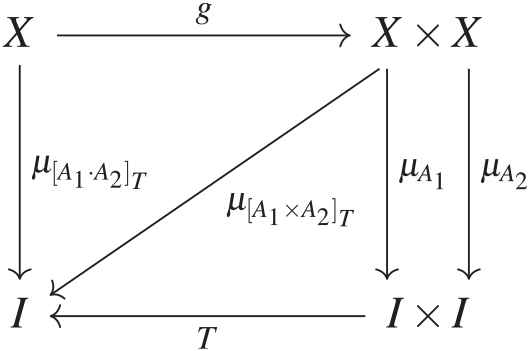
Let X be a TM-algebra and I=0,1. Define a map g:X×X→X by gx=x,x for all x∈X. We can see the relationship between T-product and the T-direct product of two T-normed fuzzy TM-subalgebras in the following diagram:

Clearly, A1⋅A2T is the preimage of A1×A2T under the map g.

Theorem 20.

Let X=X1×X2 be the direct product of TM-algebras X1 and X2. If A1=X,μA1 and A2=X,μA2 be two T- normed fuzzy TM-subalgebras of X1 and X2, respectively, then A=X,μA is a T-normed fuzzy TM-subalgebra of X defined by μAx1,x2=μA1×A2Tx1,x2=TμA1x1,μA2x2 for all x1,x2∈X1×X2.

Proof.

Let x=x1,x2 and y=y1,y2 be any elements of X. We have

μAx*y=μAx1,x2*y1,y2=μAx1*y1,x2*y2=μA1×A2Tx1*y1,x2*y2=TμA1x1*y1,μA2x2*y2⩾TTμA1x1,μA1y1,TμA2x2,μA2y2=TTμA1x1,μA2x2,TμA1y1,μA2y2=TμA1×A2Tx1,x2,μA1×A2Ty1,y2=TμAx,μAy.

Hence, A=X,μA is a T-normed fuzzy TM-subalgebra of X.

We can generalize previous theorem to the product of n T-normed fuzzy TM-algebras using the function Tn defined in Definition 9.

Theorem 21.

Let T be a t-norm and let Xii=1n be the finite collection of TM-algebras and X=∏i=1nXi the direct product TM-algebras of Xi. Let Ai be a T-normed fuzzy TM-subalgebra of Xi, where 1⩽i⩽n. Then A=∏i=1nAi defined by μAx1,x2,⋯,xn=μ∏i=1nAiTx1,x2,⋯,xn=TnμA1x1,μA2x2,⋯,μAnxn is a T-normed fuzzy TM-subalgebra of the TM-algebra X.

Proof.

Let x=x1,x2,⋯,xn and y=y1,y2,⋯,yn be any elements of X=∏i=1nXi. Then,

μAx*y=μAx1*y1,x2*y2,⋯,xn*yn=TnμA1x1*y1,μA2x2*y2,⋯,μAnxn*yn⩾TnTμA1x1,μA1y1,TμA2x2,μA2y2,⋯,TμAnxn,μAnyn=TTnμA1x1,μA2x2,⋯,μAnxn,TnμA1y1,μA2y2,⋯,μAnyn=TμAx1,x2,⋯,xn,μAy1,y2,⋯,yn=TμAx,μAy.

Hence A is a T-normed fuzzy TM-subalgebra of X.

5. CONCLUSION

The previous works related to fuzzy TM-subalgebra relied on the conventional min/max t-norm/t-conorm dual combinations. But the literature on t-norms suggests that there exists other widely accepted t-norms. In this article, we put forth a new notion of T-normed fuzzy TM-subalgebra of TM-algebra by generalizing the concept of fuzzy TM-subalgebra (defined using minimum t-norm) introduced in [25]. We observed that our generalized concept satisfy most of the various theorems stated in the previous related works. The theorem (Theorem 14 of [25]) which is stated as “A is a fuzzy TM-subalgebra of a TM-algebra X if and only if its level set UμA;α is either empty or a TM-subalgebra for all α∈0,1,” is found to be different in our generalized case. Theorems 11 and 12 in this article shows that this may not hold in the case of a T-normed fuzzy TM-subalgebra in general, but the level set can be a T-normed fuzzy TM-subalgebra when the corresponding fuzzy set A is an idempotent T-normed fuzzy TM-subalgebra. The converse part of the theorem always holds.

Moreover, we studied the properties of image and the inverse image of a T-normed fuzzy TM-subalgebra under a homomorphism. The relationship between the T-direct product and T-product of T-normed fuzzy TM-subalgebras is also obtained. In this paper, we focused on the t-norms and so this can be extended by exploring the analogous observations for the t-conorms in a fuzzy TM-algebra based on the duality between these operators.

CONFLICT OF INTEREST

All authors have no conflict of interest to report.

AUTHORS' CONTRIBUTIONS

All authors contributed equally in developing the concepts, analysing of the results and to the writing of the manuscript.

Funding Statement

No funding to declare.

ACKNOWLEDGMENTS

The authors would like to express their gratitude to the editors and the anonymous reviewers for their comments and suggestions which improved the quality of the paper. We also thank EUSFLAT Society for providing the exemption from the article processing fee.

REFERENCES

3.B. Schweizer and A. Sklar, Probabilistic Metric Spaces, North-Holland, New York, 1983.
10.C. Alsina, E. Trillas, and L. Valverde, On non-distributive logical connectives for fuzzy sets theory, Busefal, Vol. 3, 1980, pp. 18-29.
11.H. Prade, Unions et intersections d’ensemble flous, Busefal, Vol. 3, 1980, pp. 58-62.
18.Y.B. Jun, M.A. Ozturk, and E.H. Roh, Triangular normed fuzzy subalgebras of BCK-algebras, Sci. Math. Jpn., Vol. 61, 2005, pp. 451-458.
19.W.A. Dudek, K.H. Kim, and Y.B. Jun, Fuzzy BCC-subalgebras of BCC-algebras with respect to a t-norm, Sci. Math. Jpn., Vol. 3, 2000, pp. 99-106.
21.T. Senapati, T-fuzzy KU-subalgebras of KU-algebras, Ann. Fuzzy Math. Inform., Vol. 10, 2015, pp. 261-270.
26.M. Chandramouleeswaran, R. Anusuya, and P. Muralikrishna, On L-fuzzy subalgebras of TM-algebras, Adv. Theor. Appl. Math., Vol. 6, 2011, pp. 547-558.
27.S.M. Mostafa, M.A. Naby, and O.R. Elgendy, Fuzzy TM-ideals of TM-algebras, J. Am. Sci., Vol. 7, 2011, pp. 17-21.
28.T. Ramachandran, T. Priya, and M. Parimala, Anti-fuzzy T-ideals of TM-algebras and its lower level cuts, Int. J. Comp. Appl., Vol. 43, 2012, pp. 17-22.
30.M. Akram and K.H. Dar, Fuzzy associative I-ideals of IS-algebras with t-norms, Ann. Univ. Craiova Math. Comput. Sci. Ser., Vol. 33, 2006, pp. 8-15.
Journal
International Journal of Computational Intelligence Systems
Volume-Issue
12 - 2
Pages
706 - 712
Publication Date
2019/07/17
ISSN (Online)
1875-6883
ISSN (Print)
1875-6891
DOI
10.2991/ijcis.d.190704.001How to use a DOI?
Copyright
© 2019 The Authors. Published by Atlantis Press SARL.
Open Access
This is an open access article distributed under the CC BY-NC 4.0 license (http://creativecommons.org/licenses/by-nc/4.0/).

Cite this article

TY  - JOUR
AU  - Julie Thomas
AU  - K. Indhira
AU  - V. M. Chandrasekaran
PY  - 2019
DA  - 2019/07/17
TI  - T-Normed Fuzzy TM-Subalgebra of TM-Algebras
JO  - International Journal of Computational Intelligence Systems
SP  - 706
EP  - 712
VL  - 12
IS  - 2
SN  - 1875-6883
UR  - https://doi.org/10.2991/ijcis.d.190704.001
DO  - 10.2991/ijcis.d.190704.001
ID  - Thomas2019
ER  -