International Journal of Computational Intelligence Systems

Volume 12, Issue 2, 2019, Pages 809 - 821

Information Structures in an Incomplete Interval-Valued Information System

Authors
Jiasheng Zeng1, Zhaowen Li2, *, Meng Liu3, *, Shimin Liao3
1School of Mathematics and Statistics, Hunan University of Commerce, Changsha, Hunan, China
2Key Laboratory of Complex System Optimization and Big Data Processing in Department of Guangxi Education, Yulin Normal University, Yulin, Guangxi, China
3School of Science, Guangxi University for Nationalities, Nanning, Guangxi, China
*Corresponding authors. Email: 402503@gxun.edu.cn, lizhaowen8846@126.com
Corresponding Authors
Zhaowen Li, Meng Liu
Received 2 February 2019, Accepted 10 July 2019, Available Online 25 July 2019.
DOI
10.2991/ijcis.d.190712.001How to use a DOI?
Keywords
Incomplete interval-valued information system; Granular computing; Information granule; Information structure; Dependence; Information distance
Abstract

An incomplete interval-valued information system (IIVIS) is an information system (IS) in which the information values are interval numbers with missing values. This article researches information structures in an IIVIS. First, information structures in an IIVIS are obtained. In addition, the dependence and information distance are presented. The properties of information structures are investigated. Furthermore, group and lattice characterizations of information structures in an IIVIS are studied. Lastly, the θ-rough entropy is explored as an application of the proposed information structures.

Copyright
© 2019 The Authors. Published by Atlantis Press SARL.
Open Access
This is an open access article distributed under the CC BY-NC 4.0 license (http://creativecommons.org/licenses/by-nc/4.0/).

1. INTRODUCTION

Granular computing (GrC), developed by Zadeh [1–4], is vital in solving multilevel and multi-perspective problems. GrC abstracts the ideas of granular processing in various disciplines, allowing further exploration of structured thinking, structured problem-solving, and structured information processing. Information granules are an essential notion of GrC. A granule refers to the blocks formed by some individuals through unclear relations, similar relations, adjacent relations, or functional relations. It is obvious that a collection of information granules can constitute a vector that is said to be a granular structure. Since the importance of GrC was highlighted by Lin [5,6] and Yao [7–9], people have recognized this concept.

Rough set theory was presented by Pawlak [10,11]. This theory is a significant approach for managing uncertainty. One of the advantages of a rough set is that it does not need any preliminary or additional data information, but it is directly based on the original data, so it is more objective and credible. Many applications of rough set theory are connected with information systems (ISs) [12–17].

Given an IS, an equivalence relation of each attribute subset can be determined, which is a special similarity between two objects and divides the object set into some disjoint classes; these classes are regarded as equivalence classes. Each equivalence class is looked upon as an information granule [12]. The collection of all these equivalence classes constitutes a vector that is referred to as an information structure.

In this regard, many scholars have made contributions. For instance, Zhang et al. [18] explored information structures in a fully fuzzy IS. Chen et al. [19] presented information structures in a lattice-valued IS. Qian et al. [20] discussed knowledge structures in a knowledge base. Li et al. [21] considered relationships between knowledge bases. Tang et al. [22] discussed information structures in a lattice-valued IS. Xia et al. [23] researched information structures in set-valued ISs from a GrC viewpoint. Xie et al. [24] investigated information structures and uncertainty measures in an incomplete probabilistic set-valued IS. Yu. [25] studied information structures in an incomplete IS. Their findings have been proven to be useful for knowledge discovery in ISs or knowledge bases [26]. Obviously, information structures or knowledge structures can be seen as granular structures under the significance of GrC.

An incomplete interval-valued information system (IIVIS) means an IS where its information values are interval numbers with missing values. Nevertheless, information structures in an IIVIS under a framework of GrC have not been investigated. Therefore, this article focuses on this topic. The work process is displayed in Figure 1.
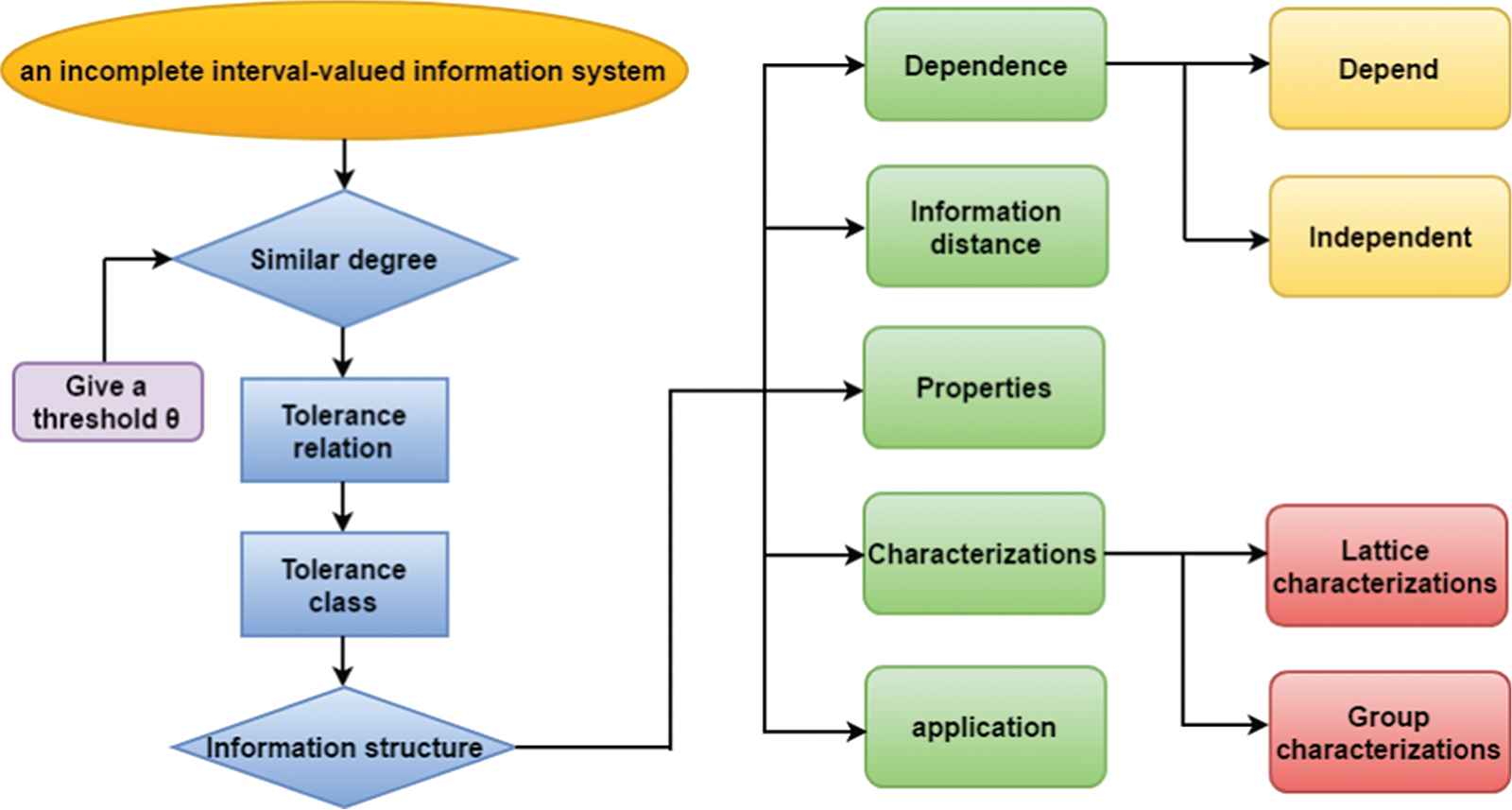
Figure 1

The work process of the article.

Why do we consider information structures in an IIVIS? This is because information structures in an IIVIS are helpful for knowledge discovery from an IIVIS. Why do we consider information granules and information structures together? This is because information granules are constructed, and then information structures can be established.

The rest of this article is designed as follows. Section 2 reviews the essential notions of binary relations, interval numbers and an IIVIS. Section 3 gives the similarity degree and tolerance relations in an IIVIS. Section 4 obtains information structures and studies the dependence, information distance and properties of information structures in an IIVIS. Section 5 studies group and lattice characterizations of information structures in an IIVIS. Section 6 investigates the entropy measure of uncertainty for an IIVIS. Section 7 discusses and concludes this article.

2. PRELIMINARIES

In this section, the essential notions of binary relations, interval numbers and an IIVIS are reviewed.

In this article, U signifies the finite universe, 2U expresses a set of all subsets of U, and |X| means the number of elements in X∈2U.

Let

U=u1,u2,⋯,un,
δ=U×U,Δ=u,u:u∈U.

2.1. Binary Relations

R is said to be a binary relation on U whenever R⊆U×U. If u,v∈R, then xRy.

Let R be a binary relation on U. Then, R is regarded as a universal relation on U whenever R=δ; R is regarded as an identity relation on U whenever R=Δ.

Assume that R is a binary relation on U. Then, R is referred to as an equivalence relation on U if R meets the following requirements:

  1. Reflexive: ∀ u∈U, uRu;

  2. Symmetric: ∀ u,v∈U, uRv implies uRv;

  3. Transitive: ∀ u,v,w∈U, uRv and vRw imply uRw.

In addition, R is said to be a tolerance relation on U if R is reflexive and symmetric.

2.2 Interval-Valued Numbers

Let

R=m=m−,m+:m−,m+∈R, m−⩽m+.

For any m∈R, express m¯=m,m.

For any m,n∈R, define

  1. m=n⇔m−=n−,m+=n+.

  2. m⩽n⇔m−⩽n−,m+⩽n+; m<n⇔m⩽n, m≠n.

Definition 2.1.

[27,28] Let m,n∈R. Then, the possible degree of m relative to n is defined as follows:

pm,n=min1,maxm+−n−m+−m−+n+−n−,0.

Proposition 2.2.

[28,29] The following properties hold:

  1. ∀ m,n∈R, 0⩽pm,n⩽1;

  2. ∀ m∈R, pm,m=0.5;

  3. ∀ m,n∈R, pm,n+pn,m=1.

Definition 2.3.

[30] Let m,n∈R. Then, the similarity degree of m and n is defined as follows:

vm,n=1−|pm,n−pn,m|.

Proposition 2.4.

[30] The following properties hold:

  1. ∀ m,n∈R, vm,n=vn,m;

  2. ∀ m,n∈R, 0⩽vm,n⩽1;

  3. ∀ m,n∈R, vm,n=1 ⇔ m=n.

Example 2.5.

[31] Pick m=5,7 and n=6,8. Then,

pm,n=min1,max7−67−5+8−6,0=14,
pn,m=min1,max8−57−5+8−6,0=34,
v(m,n)=1−|p(m,n)−p(n,m)|=1−14−34=0.5.

2.3. An IIVIS

Definition 2.6.

[32] Let U be a finite set of objects. A expresses a finite set of attributes. Then, the ordered pair U,A is referred to as an IS if a∈A is able to determine a function a:U→Va, where Va=au:u∈U.

If U,A is an IS, given B⊆A, we can then define

indB=u,v∈U×U:∀ a∈P, au=av.

Evidently, indB is an equivalence relation on U, and indB=∩a∈P inda.

Denote

uB=v∈U:u,v∈indB.

Then, uB is known as the equivalence class of the object u under the equivalence relation indB.

Definition 2.7.

[32] Let U,A be an IS. Then, U,A is known as an incomplete IS if there are u∈U and a∈A such that au is missing.

We call U,A an incomplete IS. Given B⊆A, then a binary relation on U can be defined as

simB=u,v∈U×U:∀ a∈P,
au=av or au=* or av=*,

Here, * is a missing value.

Evidently, simB is a tolerance relation on U, and simB=∩a∈P sima.

For each a∈A, denote

Va*=Va−au:au=*.

Va* means the set of all non-missing information values of the attribute a.

Definition 2.8.

[33] Assuming that U,A is an IS, U,A is called an interval-valued IS if for ∀ a∈A and u∈U, au is an interval.

Definition 2.9.

[33] Assuming that U,A is an IS, U,A is called an IIVIS if U,A is both incomplete and interval-valued.

If B⊆A, then U,B is known as the subsystem of U,A.

Example 2.10.

Table 1 depicts an IIVIS U,A where U=u1,u2,⋯,u10 and A=a1,a2,⋯,a6.

a1 a2 a3 a4 a5 a6
u1 [2.17,2.86] [1.78,2.98] [6.37,10.28] [3.01,3.84] [7.24,10.47] [2.54,3.12]
u2 * [1.42,2.09] [5.32,7.23] [3.41,5.28] [7.12,11.26] [3.24,4.70]
u3 [2.17,2.86] [1.78,2.98] * [3.06,4.65] [7.24,10.47] [2.54,3.12]
u4 * [1.78,2.98] [5.32,7.23] * [7.24,10.47] [2.06,2.79]
u5 [2.17,2.86] * [6.37,10.28] [3.06,4.65] * [2.06,2.79]
u6 [2.17,2.86] [1.42,2.09] [5.32,7.23] [3.06,4.65] [7.12,11.26] [2.54,3.12]
u7 * [1.78,2.98] [5.32,7.23] [3.01,3.84] [7.12,11.26] [3.24,4.70]
u8 [2.17,2.86] [1.78,2.98] * [3.01,3.84] [7.24,10.47] [2.54,3.12]
u9 [2.17,2.86] [1.78,2.98] [6.37,10.28] [3.01,3.84] [7.24,10.47] [3.24,4.70]
u10 [1.83,2.70] [1.42,2.09] [6.37,10.28] [3.06,4.65] [7.12,11.26] [2.06,2.79]

IIVIS, incomplete interval-valued information system.

Table 1

An IIVIS.

Example 2.11.

(Continued from Example 2.10)

Va1*=2.17,2.86,1.83,2.70,Va2*=1.78,2.98,1.42,2.09,Va3*=6.37,10.28,5.32,7.23,Va4*=3.01,3.84,3.41,5.28,3.06,4.65,Va5*=7.24,10.47,7.12,11.26,Va6*=Va6=2.54,3.12,3.24,4.70,2.06,2.79.

3. TOLERANCE RELATIONS IN AN IIVIS

In this section, the similarity degree between two information values on a given attribute in an IIVIS is constructed, and the tolerance relation induced by a given subsystem is given.

3.1. The Similarity Degree between two Information Values on a Given Attribute

Why do we consider the similarity degree between two information values? This is because we can introduce the tolerance relation in an IIVIS by the similarity degree. Based on the introduced tolerance relation, we can obtain the tolerance class of each object, and the tolerance class is looked upon as the information granule.

Definition 3.1.

Suppose that U,A is an IIVIS. Then, ∀ u,v∈U, a∈A, the similarity degree between au and av is defined as follows:

sau,av=     1u=v;1|Va*|2u≠v, au=*, av=*;1|Va*|u≠v, au≠*, av=*;1|Va*|u≠v, au=*, av≠*;     1u≠v, au≠*, av≠*,au=av;vau,avu≠v, au≠*, av≠*,au≠av.

For the convenience of expression, denote

sijk=sakui,akuj.

sijk indicates the similarity degree between akui and akuj. This parameter also expresses the similarity degree between two objects ui and uj with respect to the attribute ak.

Example 3.2.

(Continued from Example 2.10) ∀ i,j,k, sijk is obtained as follows (see Tables 2–7).

sij1 u1 u2 u3 u4 u5 u6 u7 u8 u9 u10
u1 1 12 1 12 1 1 12 1 1 0.68
u2 12 1 12 14 12 12 14 12 12 12
u3 1 12 1 12 1 1 12 1 1 0.68
u4 12 14 12 1 12 12 14 12 12 12
u5 1 12 1 12 1 1 12 1 1 0.68
u6 1 12 1 12 1 1 12 1 1 0.68
u7 12 14 12 14 12 12 1 12 12 12
u8 1 12 1 12 1 1 12 1 1 0.68
u9 1 12 1 12 1 1 12 1 1 0.68
u10 0.68 12 0.68 12 0.68 0.68 12 0.68 0.68 1
Table 2

sij1.

sij2 u1 u2 u3 u4 u5 u6 u7 u8 u9 u10
u1 1 0.33 1 1 12 0.33 1 1 1 0.33
u2 0.33 1 0.33 0.33 12 1 0.33 0.33 0.33 1
u3 1 0.33 1 1 12 0.33 1 1 1 0.33
u4 1 0.33 1 1 12 0.33 1 1 1 0.33
u5 12 12 12 12 1 12 12 12 12 12
u6 0.33 1 0.33 0.33 12 1 0.33 0.33 0.33 1
u7 1 0.33 1 1 12 0.33 1 1 1 0.33
u8 1 0.33 1 1 12 0.33 1 1 1 0.33
u9 1 0.33 1 1 12 0.33 1 1 1 0.33
u10 0.33 1 0.33 0.33 12 1 0.33 0.33 0.33 1
Table 3

sij2.

sij3 u1 u2 u3 u4 u5 u6 u7 u8 u9 u10
u1 1 0.30 12 0.30 1 0.30 0.30 12 1 1
u2 0.30 1 12 1 0.30 1 1 12 0.30 0.30
u3 12 12 1 12 12 12 12 14 12 12
u4 0.30 1 12 1 0.30 1 1 12 0.30 0.30
u5 1 0.30 12 0.30 1 0.30 0.30 12 1 1
u6 0.30 1 12 1 0.30 1 1 12 0.30 0.30
u7 0.30 1 12 1 0.30 1 1 12 0.30 0.30
u8 12 12 14 12 12 12 12 1 12 12
u9 1 0.30 12 0.30 1 0.30 0.30 12 1 1
u10 1 0.30 12 0.30 1 0.30 0.30 12 1 1
Table 4

sij3.

sij4 u1 u2 u3 u4 u5 u6 u7 u8 u9 u10
u1 1 0.32 0.64 13 0.64 0.64 1 1 1 0.64
u2 0.32 1 0.72 13 0.72 0.72 0.32 0.32 0.32 0.72
u3 0.64 0.72 1 13 1 1 0.64 0.64 0.64 1
u4 13 13 12 1 13 13 13 13 13 13
u5 0.64 0.72 1 13 1 1 0.64 0.64 0.64 1
u6 0.64 0.72 1 13 1 1 0.64 0.64 0.64 1
u7 1 0.32 0.64 13 0.64 0.64 1 1 1 0.64
u8 1 0.32 0.64 13 0.64 0.64 1 1 1 0.64
u9 1 0.32 0.64 13 0.64 0.64 1 1 1 0.64
u10 0.64 0.72 1 13 1 1 0.64 0.64 0.64 1
Table 5

sij4.

sij5 u1 u2 u3 u4 u5 u6 u7 u8 u9 u10
u1 1 0.91 1 1 12 0.91 0.91 1 1 0.91
u2 0.91 1 0.91 0.91 12 1 1 0.91 0.91 1
u3 1 0.91 1 1 12 0.91 0.91 1 1 0.91
u4 1 0.91 1 1 12 0.91 0.91 1 1 0.91
u5 12 12 12 12 1 12 12 12 12 12
u6 0.91 1 0.91 0.91 12 1. 1 0.91 0.91 1
u7 0.91 1 0.91 0.91 12 1 1 0.91 0.91 1
u8 1 0.91 1 1 12 0.91 0.91 1 1 0.91
u9 1 0.91 1 1 12 0.91 0.91 1 1 0.91
u10 0.91 1 0.91 0.91 12 1 1 0.91 0.91 1
Table 6

sij5.

sij6 u1 u2 u3 u4 u5 u6 u7 u8 u9 u10
u1 1 0 1 0.38 0.38 1 0 1 0 0.38
u2 0 1 0 0 0 0 1 0 1 0
u3 1 0 1 0.38 0.38 1 0 1 0 0.38
u4 0.38 0 0.38 1 1 0.38 0 0.38 0 1
u5 0.38 0 0.38 1 1 0.38 0 0.38 0 1
u6 1 0 1 0.38 0.38 1 0 1 0 0.38
u7 0 1 0 0 0 0 1 0 1 0
u8 1 0 1 0.38 0.38 1 0 1 0 0.38
u9 0 1 0 0 0 0 1 0 1 0
u10 0.38 0 0.38 1 1 0.38 0 0.38 0 1
Table 7

sij6.

3.2. Tolerance Relations in an IIVIS

Definition 3.3.

Consider that U,A is an IIVIS. Given θ∈0,1 and B⊆A, then RBθ⊆U×U can be defined as shown below.

RBθ=u,v∈U×U:∀ a∈B, sau,av⩾θ.

Obviously, RBθ⊆U×U is a tolerance relation, and RBθ=∩a∈B Raθ.

In addition, if B=a, then RBθ=Raθ, which can be briefly expressed as RBθ=Raθ.

Proposition 3.4.

Let U,A be an IIVIS. We can obtain the following properties:

  1. If B1⊆B2⊆A, then ∀ θ∈0,1 and u∈U,

    RB2θu⊆RB1θu;

  2. If 0⩽θ1⩽θ2⩽1, then ∀ B⊆A and u∈U,

    RBθ2u⊆RBθ1u.

Proof.

This proof is clear.

Corollary 3.5.

Assume that U,A is an IIVIS. If C⊆B⊆A and 0⩽θ1⩽θ2⩽1, then RBθ2⊆RCθ1.

Proof.

This can be obtained from Proposition 3.4.

Proposition 3.6.

Suppose that U,A is an IIVIS. Then, ∀ B,C⊆A and θ∈0,1, RBθ∩​RCθ=RB∪​Cθ.

Proof.

This result can be obtained from Definition 3.3 and Proposition 3.4.

Definition 3.7.

Let U,A be an IIVIS. Given θ∈0,1 and B⊆A, then ∀ u∈U, the tolerance class of u under RBθ is defined as

RBθu=v∈U:u,v∈RBθ.

Clearly, RBθu=∩a∈B Raθu.

Corollary 3.8.

Suppose that U,A is an IIVIS.

  1. If C⊆B⊆A, then ∀ θ∈0,1, RBθ⊆RCθ.

  2. If 0⩽θ1⩽θ2⩽1, then ∀ B⊆A, RBθ2⊆RBθ1.

Proof.

This result can be obtained from Proposition 3.4.

Corollary 3.9.

Given that U,A is an IIVIS. If C⊆B⊆A, 0⩽θ1⩽θ2⩽1 and u∈U, then RBθ2u⊆RCθ1u.

Proof.

This result can be obtained by Corollary 3.8.

Corollary 3.10.

Consider that U,A is an IIVIS. Then, ∀ B,C⊆A, θ∈0,1 and u∈U, RBθu∩​RCθu=RB∪​Cθu.

Proof.

This result can be obtained from Proposition 3.6.

Example 3.11.

(Continued from Example 3.2)

Select θ=0.4. Then, for any i and u∈U, the tolerance class Raiθu of the object u is obtained (see Tables 8 and 9).

Ra1θu Ra2θu Ra3θu
u1 U U−u2,u6,u10 U−u2,u4,u6,u7
u2 U−u4,u7 u2,u5,u6,u10 U−u1,u5,u9,u10
u3 U U−u2,u6,u10 U−u8 
u4 U−u2,u7 U−u2,u6,u10 U−u1,u5,u9,u10
u5 U U U−u2,u4,u6,u7
u6 U u2,u5,u6,u10 U−u1,u5,u9,u10
u7 U−u2,u4 U−u2,u6,u10 U−u1,u5,u9,u10
u8 U U−u2,u6,u10 U−u3 
u9 U U−u2,u6,u10 U−u2,u4,u6,u7
u10 U u2,u5,u6,u10 U−u2,u4,u6,u7
Table 8

The tolerance class of each object under Raθa=a1,a2,θ=0.4.

Ra4θu Ra5θu Ra6θu
u1 U−u2,u4 U u1,u3,u6,u8
u2 u2,u3,u5,u6,u10 U u2,u7,u9
u3 U−u4 U u1,u3,u6,u8
u4 u4 U u4,u5,u10
u5 U−u4 U u4,u5,u10
u6 U−u4 U u1,u3,u6,u8
u7 U−u2,u4 U u2,u7,u9
u8 U−u2,u4 U u1,u3,u6,u8
u9 U−u2,u4 U u2,u7,u9
u10 U−u4 U u4,u5,u10
Table 9

The tolerance class of each object under Raθa=a4,a5,a6,θ=0.4.

Thus, RAθu1=u1,u3,u8,RAθu2=u2,

RAθu3=u1,u3,u8,RAθu4=u4,

RAθu5=u5,u10,RAθu6=u6,

RAθu7=u7,RAθu8=u1,u8,

RAθu9=u9,RAθu10=u5,u10.

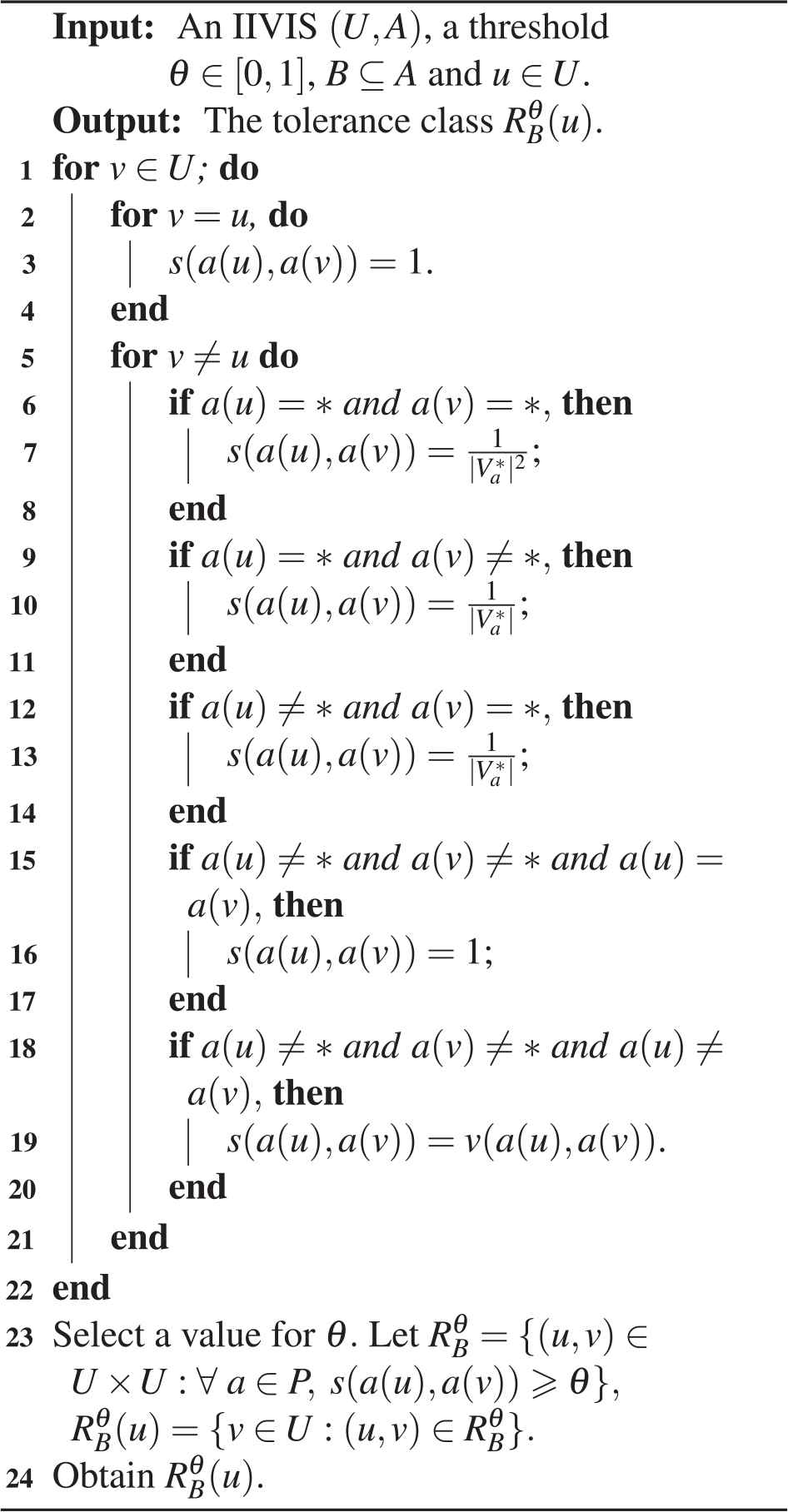
An algorithm for computing the tolerance class is designed as follows:

4. INFORMATION STRUCTURES IN AN IIVIS

In this section, information structures in an IIVIS are presented.

4.1. Information Granules and Information Structures

Suppose that U,A is an IIVIS. Given ∀ B⊆A and θ∈0,1, a tolerance relation RBθ on U is obtained. For ∀ i, RBθui can be referred to as the information granule of the point ui. Then, the concept of an information structure is presented as below.

Algorithm 1: Computing RBθu.

Definition 4.1.

Let U,A be an IIVIS. Given θ∈0,1 and B⊆A. Then,

SθB=RBθu1,RBθu2,⋯⋯,RBθun

Then, SθB is said to be the information structure of U,B in relation to θ.

Definition 4.2.

Let U,A be an IIVIS. Let θ1,θ2∈0,1 and B,C⊆A. If ∀ i, RBθ1ui=RCθ2ui, then Sθ1B and Sθ2C are deemed to be the same. This expression can be written as Sθ1B=Sθ2C.

Definition 4.3.

Let U,A be an IIVIS. Given θ∈0,1, let

SθU,A=SθB:B⊆A.

Then, SθU,A is said to be the θ-information structure base of U,A.

4.2. Dependence between Information Structures

Definition 4.4.

Given that (U,A) is an IIVIS, suppose that θ1,θ2∈0,1 and B,C⊆A.

  1. Sθ2C is referred to as depending on Sθ1B if for each i, RBθ1ui⊆RCθ2ui; we can write Sθ1B⪯Sθ2C. Sθ2C is known to depend strictly on Sθ1B if Sθ1B⪯Sθ2C and Sθ1B≠Sθ2C; we can write Sθ1B≺Sθ2C.

  2. Sθ2C is referred to as partially dependent on Sθ1B if there exists i such that RBθ1ui⊆RCθ2ui; we can write Sθ1B⊑Sθ2C. Sθ2C is known as to depend strictly on Sθ1B if Sθ1B⊑Sθ2C and Sθ1B≠Sθ2C; we can write Sθ1B⊏Sθ2C.

  3. Sθ2C is referred to as independent of Sθ1B if for each i, RBθ1ui⊈RCθ2ui; we can write Sθ1B⋈Sθ2C.

The following conclusions can be obtained clearly.

Sθ1B=Sθ2C ⇔ Sθ1B⪯Sθ2C and Sθ2C⪯Sθ1B,Sθ1B⪯Sθ2C⇒Sθ1B⊑Sθ2C,Sθ1B≺Sθ2C⇒Sθ1B⊏Sθ2C.

4.3. Information Distance between Information Structures

The information distance between information structures is presented below.

For P,Q∈2U, denote

P⊕Q=P∪​Q−P∩​Q.

Thus, P⊕Q is referred to as the symmetric difference between P and Q.

Clearly, |P⊕Q|=|P∪​Q|−|P∩​Q|.

Theorem 4.5.

[18] Suppose P,Q∈2U. Then

P=Q⇔|P⊕Q|=0.

Theorem 4.6.

[18] Assume P,Q,L∈2U. Then

|P⊕Q|+|Q⊕L|⩾|P⊕L|.

Theorem 4.7.

[18] Suppose P,Q,L∈2U. If P⊆Q⊆L or L⊆Q⊆P, then

|P⊕Q|+|Q⊕L|=|P⊕L|.

Definition 4.8.

Let U,A be an IIVIS. Suppose that B,C⊆A, as well as θ∈0,1. Then, the information distance between SθB and SθC is defined as

ρSθB,SθC=1n2∑i=1n|RBθui⊕RCθui|.

Theorem 4.9.

Assuming that U,A is an IIVIS and θ∈0,1, then SθU,A,ρ is a distance space.

Proof.

Suppose that B,C,D⊆A and θ∈0,1. By Definition 4.8,

ρSθB,SθC⩾0, ρSθB,SθC=ρSθC,SθB

By Theorem 4.14,

ρSθB,SθC=0⇔∀ i,|RBθui⊕RCθui|=0                   ⇔∀ i,RBθui=RCθui⇔SθB=SθC

By Theorem 4.6,

|RBθui⊕RCθui|+|RCθui⊕RDθui|⩾|RBθui⊕RDθui|.

Then,

ρSθB,SθC+ρSθC,SθD
=1n2∑i=1n|RBθui⊕RCθui|+1n2∑i=1n|RCθui⊕RDθui|=1n2∑i=1n|RBθui⊕RCθui|+|RCθui⊕RDθui|⩾1n2∑i=1n|RBθui⊕RDθui|=ρSθB,SθD.

Evidence must be obtained.

Proposition 4.10.

Suppose that U,A is an IIVIS and θ∈0,1. Then, ∀ B,C⊆A,

  1. 0⩽ρSθB,SθC⩽1−1n;

  2. If SθB⪯SθC and RDθ is an identify relation on U, then ρSθB,SθD⩽ρSθC,SθD;

  3. If SθB⪯SθC, then ρSθB,SθØ⩾ρSθC,SθØ.

Proof.

1 It is obvious that 1⩽|RBθui∪​RCθui|⩽n and 1⩽|RBθui∩​RCθui|⩽n i=1,2,⋯,n. Then,

0⩽|RBθui⊕RCθui|⩽n−1i=1,2,⋯,n.

By Definition 4.8,

0⩽ρSθB,SθC⩽1n2∑i=1nn−1=1−1n.

2 Because of SθB⪯SθC, ∀ i, RBθui⊆RCθui. By Definition 4.8,

ρSθB,SθD=1n2∑i=1n|RBθui⊕ui|
=1n2∑i=1n|RBθui∪​ui|−|RBθui∩​ui|
=1n2∑i=1n|RBθui|−1⩽1n2∑i=1n|RCθui|−1=ρSθC,SθD

3 On account of SθB⪯SθC, ∀ i, RBθui⊆RCθui. By Definition 4.8,

ρSθB,SθØ=1n2∑i=1n|RBθui⊕U|
=1n2∑i=1n|RBθui∪​ U|−|RBθui∩​U|
=1n2∑i=1nn−|RBθui|⩾1n2∑i=1nn−|RCθui|=ρSθC,SθØ

Proposition 4.11.

Assuming that U,A is an IIVIS and θ∈0,1, if RDθ is an identify relation on U, then ∀ B⊆A,

ρSθ(B),Sθ(D)+ρSθ(B),SθØ=1−1n.

Proof.

By Definition 4.8, the following is apparent:

ρSθ(B),Sθ(D)+ρSθ(B),SθØ
=1n2∑i=1n|RBθui⊕ui|+1n2∑i=1n|RBθui⊕U|=1n2∑i=1n|RBθui|−1+1n2∑i=1nn−|RBθui|=1n2∑i=1nn−1=1−1n.

Proposition 4.12.

Suppose that U,A is an IIVIS and θ∈0,1. Then, ∀ B,C,D⊆A. If SθB⪯SθC⪯SθD or SθD⪯SθC⪯SθB, then

ρSθ(B),Sθ(C)+ρSθ(C),Sθ(D)=ρSθ(B),Sθ(D).

Proof.

Owing to SθB⪯SθC⪯SθD or SθD⪯SθC⪯SθB, it can be obtained that RBθui⊆RCθui⊆RDθui or RDθui⊆RCθui⊆RBθuii=1,2,⋯,n.

By Theorem 4.17,

|RBθui⊕RCθui|+|RCθui⊕RDθui|
=|RBθui⊕RDθui|i=1,2,⋯,n.

By Definition 4.8,

ρSθB,SθC+ρSθC,SθD
=1n2∑i=1n|RBθui⊕RCθui|+1n2∑i=1n|RCθui⊕RDθui|=1n2∑i=1n|RBθui⊕RCθui|+|RCθui⊕RDθui|=1n2∑i=1n|RBθui⊕RDθui|=ρSθB,SθD

4.4. Properties of Information Structures

Properties of information structures in an IIVIS are displayed below.

Theorem 4.13.

Assuming that U,A is an IIVIS, given θ1,θ2∈0,1 and B,C⊆A, then

Sθ1B=Sθ2C⇔RBθ1=RCθ2.

Proof.

The proof is obvious.

Theorem 4.14.

Suppose that U,A is an IIVIS. Given θ1,θ2∈0,1 and B,C⊆A. Then,

Sθ1B⪯Sθ2C⇔RBθ1⊆RCθ2.

Proof.

Obviously.

Corollary 4.15.

Consider that U,A is an IIVIS. Given θ1,θ2∈0,1 and B,C⊆A, then

Sθ1B≺Sθ2C⇔RBθ1⊂RCθ2.

Proof.

This result can be obtained by Theorem 4.13 and Theorem 4.14.

Theorem 4.16.

Assuming that U,A is an IIVIS, then ∀ B,C⊆A and θ∈0,1, these equations below are equivalent:

  1. SθB=SθC;

  2. RBθu=RCθu;

  3. RBθ=RCθ;

  4. ρSθB,SθC=0.

Proof.

1⇔2. The proof is clear.

1⇔3. The result can be obtained from Theorem 4.14.

2⇔4. The proof is obvious.

Theorem 4.17.

Let U,A be an IIVIS.

  1. If B⊆C⊆A, then ∀ θ∈0,1, SθC⪯SθB.

  2. If 0<θ1⩽θ2⩽1, then ∀ B⊆A, Sθ2B⪯Sθ1B.

Proof.

This result can be obtained from Proposition 3.4 and Theorem 4.14.

Corollary 4.18.

Suppose that U,A is an IIVIS. Given θ1,θ2∈0,1 and B,C⊆A, if B⊆C, θ1⩽θ2, then

Sθ2C⪯Sθ1C⪯Sθ1B, Sθ2C⪯Sθ2B⪯Sθ1B.

Proof.

This result can be obtained from Theorem 4.17.

Definition 4.19.

[34] Let U,A be an IIVIS. Assuming that a mapping D:SθU,A×SθU,A→0,1 is said to be the inclusion degree on SθU,A, if ∀ B,C,D⊆A.

  1. 0⩽DSθC/SθB⩽1;

  2. SθB⪯SθC means DSθC/SθB=1;

  3. SθB⊑SθC⊑SθD means DSθB/SθD⩽DSθB/SθC.

Definition 4.20.

Assuming that U,A is an IIVIS, then ∀ B,C⊆A and θ∈0,1, define

DSθC/SθB=∑l=1n|RCθul|∑i=1n|RCθui|χRCθulRBθul,
where
χRCθulRBθul=1,if  RBθul⊆RCθul,0,if  RBθul⊈RCθul.

Proposition 4.21.

D in Definition 4.20 is the inclusion degree under Definition 4.19.

Proof.

Let θ∈0,1 and B,C,D⊆A.

  1. Obviously, 0⩽DSθC/SθB⩽1.

  2. Suppose SθB⪯SθC. Then, by Theorem 4.14, RBθ⊆RCθ. Thus, for each l, RBθul⊆RCθul. This result implies that

    for each l, χRCθulRBθul=1.

    Thus, DSθC/SθB=1.

  3. Suppose SθB⪯SθC⪯SθD. Then, by Theorem 4.14, RBθ⊆RCθ⊆RDθ. Thus, for each l, RBθul⊆RCθul⊆RDθul.

By Definition 4.20,

D(Sθ(B)/Sθ(D))=∑l=1n|RBθ(ul)|∑i=1n|RBθ(ui)|χRBθ(ul)(RDθ(ul)),D(Sθ(B)/Sθ(C))=∑l=1n|RBθ(ul)|∑i=1n|RBθ(ui)|χRBθ(ul)(RCθ(ul)).

If RCθul⊈RBθul, then RDθul⊈RBθul. This result illustrates that

χRBθulRCθul=0 implies χRBθulRDθul=0.

Thus,

DSθB/SθD⩽DSθB/SθC.

From the above, we know that D is the inclusion degree.

Example 4.22.

(Continued from Example 3.11). Suppose that U,A is an IIVIS. Let B=a1, C=a5 and θ=0.4. Then,

DKB/KC=|RBu1|∑i=110|RBui|χRBu1RCu1+|RCu2|∑i=110|RBui|χRBu2RCu2+⋯+|RBu10|∑i=110|RBui|χRBu1RCu10=3547,
DKC/KB=|RCu1|∑i=110|RCui|χRCu1RBu1+|RCu2|∑i=110|RCui|χRCu2RBu2+|RCu3|∑i=110|RCui|χRCu3RBu3+|RCu10|∑i=110|RCui|χRCu10RBu10=|RCu1|∑i=110|RCui|+|RCu2|∑i=110|RCui|+|RCu3|∑i=110|RCui|+|RCu10|∑i=110|RCui|=1

Consequently,

DKB/KC+DKC/KB≠1.

It can be obtained that the inclusion degree has the ability to quantify relationships by the theorem below.

Theorem 4.23.

Assuming that U,A is an IIVIS, then ∀ B,C⊆A and θ∈0,1.

  1. SθB⪯SθC⇔DSθC/SθB=1.

  2. SθB⋈SθC⇔DSθC/SθB=0.

  3. SθB⊑SθC⇔0<DSθC/SθB⩽1.

Proof.

(1) “⇒” is evident. We prove “⇐.” Suppose

|RCθul|=ql,  ∑l=1n|RCθul|=q.

Then,

q=∑l=1nql

Owing to DSθC/SθB=1, it can be obtained that ∑l=1nqlχRCθulRBθul=∑l=1nql=q.

Then,

q1−χRCθulRBθul=0.

Consequently, ∀ l,

1−χRCθulRBθul=0.

Thus, it can be obtained that ∀ l, RBθul⊆RCθul.

By Proposition 3.4 and Theorem 4.14, SθB⪯SθC.

(2) “⇒.” Owing to SθB⋈SθC, it can be obtained that RBθul⊈ RCθul ∀ l. Then ∀ l,

χRCθulRBθul=0.

By Definition 4.20, DSθC/SθB=0.

“⇐.” Owing to DSθC/SθB=0, it can be obtained that ∀ l, χRCθulRBθul=0.

Then, ∀ l, RBθul⊈ RCθul. By Definition 4.4, SθB⋈SθC.

(3) The result can be obtained from (1) and (2).

5. CHARACTERIZATIONS OF INFORMATION STRUCTURES IN AN IIVIS

This part will present group and lattice characterizations of information structures in an IIVIS.

5.1. Group Characterizations of Information Structures

Definition 5.1.

[35] Assume that S is a nonempty set and “.” a binary operation on S.

  1. S,⋅ is said to be a semigroup if ∀ p,q∈S, p⋅q∈S and ∀ p,q,l∈S, p⋅q⋅l=p⋅q⋅l.

  2. S,⋅ is said to be an exchangeable semigroup if it is a semigroup and if ∀ p,q∈S, p⋅q=q⋅p.

  3. i∈S is said to be the identity element of S if ∀ p∈S,i⋅p=p⋅i=p.

  4. S,⋅ is said to be a group if it is a semigroup and if every element has an inverse element.

Suppose

SθB=RBθu1,RBθu2,⋯,RBθun,SθC=RBθu1,RBθu2,⋯,RBθun.

Define SθB⊙SθC

=RBθu1∩​RCθu1,RBθu2∩​RCθu2,⋯,RBθun∩​RCθun

Theorem 5.2.

SθU,A,⊙ is an exchangeable semigroup with the identity element SθØ.

Proof.

Assume B,C,D⊆A. By Corollary 3.10, we have

SθB⊙SθC
=RBθu1∩​RCθu1,RBθu2∩​RCθu2,⋯,RBθun∩​RCθun=RB∪​Cθu1,RB∪​Cθu2,⋯,RB∪​Cθun=SθB∪​C.

Similarly, SθC⊙SθB=SθC∪​B.

Thus,

SθB⊙SθC=SθC⊙SθB.

Owing to SθB⊙SθC⊙SθD=SθB∪​C⊙SθD=SθB∪​C∪​D,

SθB⊙SθC⊙SθD=SθB⊙SθC∪​D=SθB∪​C∪​D,
it can be obtained that
SθB⊙SθC⊙SθD=SθB⊙SθC⊙SθD.

By Definition 5.1, SθU,⊙ is an exchangeable semigroup.

Evidently, SθØ is the identity element.

5.2. Lattice Characterizations of Information Structures

Theorem 5.3.

Assuming that U,A is an IIVIS, then

  1. L=SθU,A,⪯ is a lattice with 1L=SθØ, 0L=SθA;

  2. If B1,B2⊆A and AB1,B2=B:B⊆A,RB1θ∪​RB2θ⊆RBθ, then

    SθB1∧SθB2=SθB1⊙SθB2=SθB1∪​B2,
    SθB1∨SθB2=⊙B∈AB1,B2SθB=Sθ∪​AB1,B2.

Proof.

Clearly, ∀ B⊆A, SθB⪯SθB.

Assuming that SθB⪯SθC and SθC⪯SθB, by Theorem 4.14, RBθ⊆RCθ, RCθ⊆RBθ. Then, RBθ=RCθ. Consequently, SθB=SθC.

Assuming that SθB⪯SθC and SθC⪯SθD, by Theorem 4.14, RBθ⊆RCθ, RCθ⊆RDθ. Then, RBθ⊆RDθ). By Theorem 4.14, SθB⪯SθD.

Accordingly, SθU,A,⪯ is a partial order set.

By proving Theorem 5.2, it can be obtained that

SθB1⊙SθB2=SθB1∪​B2,
⊙B∈AB1,B2SθB=Sθ∪​AB1,B2.

Owing to B1,B2⊆B1∪​B2, by Proposition 4.17, it can be obtained that SθB1∪​B2⪯SθB1 and SθB1∪​B2⪯SθB2. Accordingly, SθB1∪​B2 is the lower bound of SθB1,SθB2.

Assuming that SθB is the lower bound of SθB1,SθB2 with B⊆A, then SθB⪯SθB1 and SθB⪯SθB2. By Theorem 4.14, it can be obtained that RBθ⊆RB1θ and RBθ⊆RB2θ. Then, RBθ⊆RB1θ∩​RB2θ=RB1∪​B2θ. By Theorem 4.14, SθB⪯SθB1∪​B2.

Thus,

SθB1∧SθB2=SθB1∪​B2.

∀ B∈AB1,B2, owing to RB1θ∪​RB2θ⊆RBθ, it can be obtained that RB1θ,RB2θ⊆RBθ. Then,

RB1θ,RB2θ⊆∩B∈AB1,B2RBθ=R∪B∈AB1,B2Bθ=R∪​AB1,B2θ.

By Theorem 4.14, SθB1,SθB2⪯Sθ∪​AB1,B2. Then, Sθ∪​AB1,B2 is the upper bound of SθB1,SθB2.

Assuming that SθS is the upper bound of SθB1,SθB2 with S⊆A, then SθB1⪯SθS, SθB2⪯SθS. By Theorem 4.14, RB1θ⊆RSθ and RB2θ⊆RSθ. Then, S∈AB1,B2. Therefore, S⊆∪AB1,B2. By Theorem 4.17 1, Sθ∪​AB1,B2⪯SθS.

Thus, SθB1∨SθB2=Sθ∪​AB1,B2.

Therefore, L is a lattice.

It is obvious that 1L=SθØ, 0L=SθA.

Corollary 5.4.

SθU,A,∧ is an exchangeable semigroup with the identity element SθØ.

Example 5.5.

(Continued from Example 4.22) SθU,A,⪯ is not a distributive lattice.

By Theorem 5.3, L=SθU,A,⪯ is a lattice with 1L=SθØ and 0L=SθA.

The following equations can be obtained:

AB1,B2∪​B3=AB1,B6=B⊆A:RB1θ∪​RB6θ⊆RBθ=B⊆A:RB1θ⊆RBθ=Ø,B1,B2,B4,

AB1,B2=B⊆A:RB1θ∪​RB2θ⊆RBθ=B⊆A:RB2θ⊆RBθ=Ø,B2,

AB1,B3=B⊆A:RB1θ∪​RB3θ⊆RBθ=Ø.

Then,

∪​AB1,B2∪​B3=a1,a2,
∪​AB1,B2∪∪​AB1,B3=a2.

By Theorem 4.16,

Sθ∪​AB1,B2∪​B3≠Sθ∪​AB1,B2∪∪​AB1,B3.

By Theorem 5.3,

SθB1∨SθB2∧SθB3
=SθB1∨SθB2∪​B3
=Sθ∪​AB1,B2∪​B3,
SθB1∨SθB2∧SθB1∨SθB3
=Sθ∪​AB1,B2∪Sθ∪​AB1,B3
=Sθ∪AB1,B2∪∪AB1,B3.

Thus,

SθB1∨SθB2∧SθB3
≠SθB1∨SθB2∧SθB1∨SθB3.

Accordingly, SθU,A,⪯ is not a distributive lattice.

Example 5.6.

(Continued from Example 5.5) SθU,A,⊑ is not a partial order set.

It can be obtained that SθB1⊑SθB2 and SθB2⊑SθB1. However, SθB1≠SθB2. This means that ⊑ is not antisymmetric.

Therefore, SθU,A,⊑ is not a partial order set.

6. AN APPLICATION

As an application of information structures in an IIVIS, the θ-rough entropy is presented in this section.

Why do we study measures of uncertainty for an IIVIS? This is because an IIVIS itself has uncertainty. Why do we use information structures to measure the uncertainty of an IIVIS? This is because it is difficult to compare the size of measure values of uncertainty for an IIVIS. Moreover, if the dependence between two information structures are obtained, then the size of the measure values of uncertainty for an IIVIS can be compared by means of the dependence.

Definition 6.1.

Let U,A be an IIVIS. Given B⊆A and θ∈0,1, the θ-rough entropy of subsystem U,B is defined as

ErθB=−∑i=1n|RBθui|nlog21|RBθui|,
where |RBθui|n represents the probability of RBθui.

Proposition 6.2.

Assume that U,A is an IIVIS. Given B⊆A and θ∈0,1, then

0⩽ErθB⩽nlog2n.

Moreover, if RBθ=△, then Erθmin=0; if RBθ=δ, then Erθmax=nlog2n.

Proof.

Note that ∀ i, 1⩽|RBθui|⩽n, we have

0⩽−log21|RBθui|=log2|RBθui|⩽log2n,
0⩽|RBθui|n⩽1.

Then,

0⩽|RBθui|nlog21|RBθui|⩽log2n.

By Definition 6.1,

0⩽ErθB⩽nlog2n.

If RBθ=△, then ∀ i, |RBθui|=1. So ErθB=0.

If RBθ=δ, then ∀ i, |RBθui|=n. So Erθ(B)=nlog2n.

Theorem 6.3.

Let U,A be an IIVIS. Assume B,C⊆A and θ1,θ2∈0,1.

  1. If Sθ1B⪯Sθ2C, then Erθ1B⩽Erθ2C.

  2. If Sθ1B≺Sθ2C, then Erθ1B<Erθ2C.

Proof.

  1. This proof is obvious.

  2. By Definition 6.1,

    Erθ1B=−∑i=1n|RBθ1ui|nlog21|RBθ1ui|,Erθ2C=−∑i=1n|RCθ2ui|nlog21|RCθ2ui|.

Note that Sθ1B≺Sθ2C. Then, ∀ i, RBθ1ui⊆RCθ2ui and ∃ j, RBθ1uj⊊SCθ2uj. Thus,  ∀ i, |RBθ1ui|⩽|RCθ2ui| and ∃ j, |RBθ1uj|<|SCθ2uj|.

Hence,  ∀ i,

−|RBθ1ui|log21|RBθ1ui|=|RBθ1ui|log2|RBθ1ui|⩽|RCθ2ui|log2|RCθ2ui|=−|RCθ2ui|log21|RCθ2ui|,∃j−|RBθ1uj|log21|RBθ1uj|=|RBθ1uj|log2|RBθ1uj|<|SCθ2uj|log2|SCθ2uj|=−|SCθ2uj|log21|SCθ2uj|.

Hence, Erθ1B<Erθ2C.

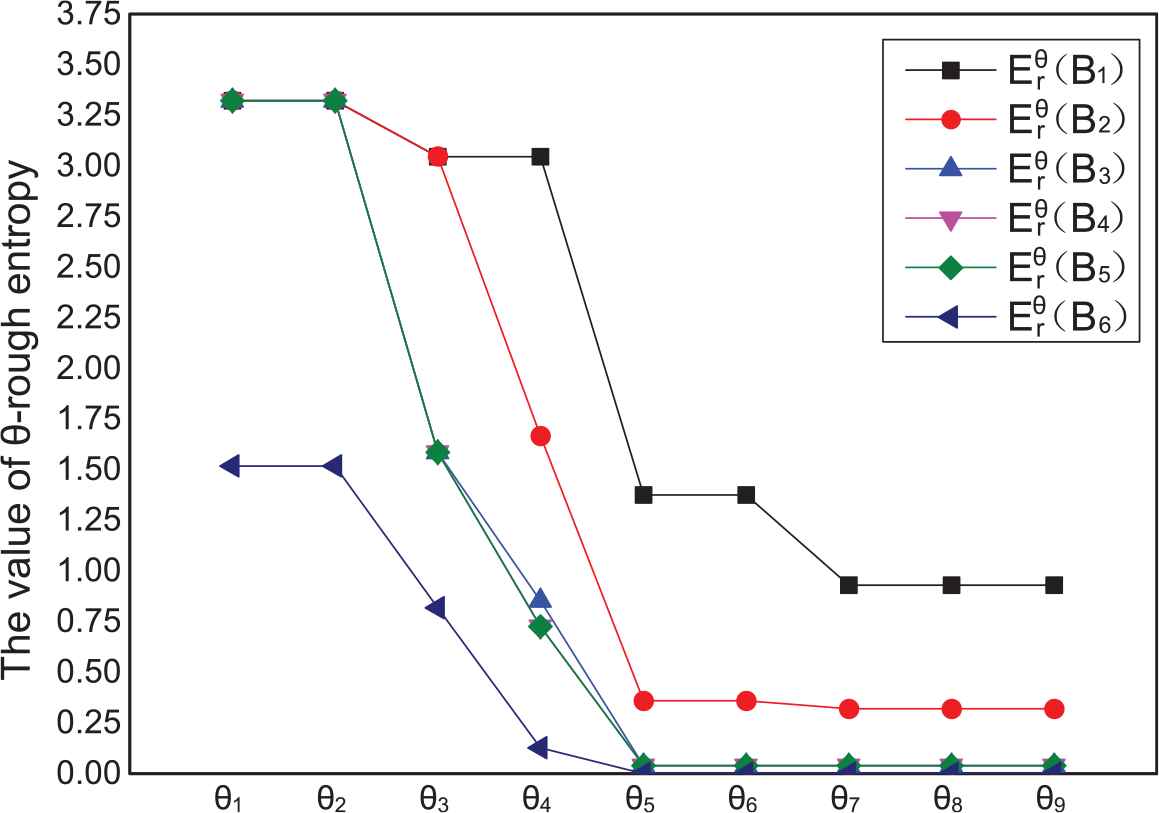
This proposition clarifies that the θ-rough entropy value increases as the available information becomes more uncertain. Therefore, it can be concluded that the θ-rough entropy presented in Definition 6.1 can evaluate the uncertainty of an IIVIS.

Proposition 6.4.

Let (U, A) be an IIVIS.

  1. If B⊆C with B,C⊆A, then for any θ∈0,1, ErθC⪯ErθB.

  2. If 0<θ1⩽θ2⩽1, then for any B⊆A, Erθ2B⪯Erθ1B.

Proof.

This result follows from Proposition 3.4 and Theorem 6.3.

Corollary 6.5.

Let U,A be an IIVIS. Given θ1,θ2∈0,1 and B,C⊆A. If B⊆C, θ1⩽θ2, then

Erθ2(C)⪯Erθ1(C)⪯Erθ1(B), Erθ2(C)⪯Erθ2(B)⪯Erθ1(B).

Proof.

This result follows from Proposition 6.4.

Select θ1=0.1,θ2=0.2,⋯,θ9=0.9 and B1=a1, B2=a1,a2, …, B8=a1,a2…,a6=A. We compare EθBi with θ under the same object, as shown in Figure 2.

Figure 2

The change of the θ-rough entropy with different θ.

7. CONCLUSIONS

This article has investigated information structures in an IIVIS. The concept of information structures has been introduced. The dependence and information distance between information structures in an IIVIS have been presented. In addition, group and lattice characterizations of information structures have been obtained. As an application, the θ-rough entropy of uncertainty for information structures in an IIVIS has been shown. We plan to study other applications of the information structures.

CONFLICTS OF INTEREST

The authors declare no conflict of interest.

AUTHOR CONTRIBUTIONS

All authors contribute equally in this work in all parts and in all steps.

Funding Statement

Natural Science Foundation of Guangxi (2018GXNSFDA294003,2018GXNSFAA294134), Key Laboratory of Software Engineering in Guangxi University for Nationali-ties (2018-18XJSY-03), and Engineering Project of Undergraduate Teaching Reform of Higher Education in Guangxi (2017JGA179).

REFERENCES

5.T.Y. Lin, Granular computing on binary relations I: data mining and neighborhood systems, A. Skowron and L. Polkowski (editors), Rough Sets in Knowledge Discovery, Physica-Verlag, New York, 1998, pp. 107-121.
33.Y.Y. Yao and N. Noroozi, A unified framework for set-based computations, San Jose State University, in Proceedings of the 3rd International Workshop on Rough Sets and Soft Computing, 1994, pp. 10-12.
34.W.X. Zhang and G.F. Qiu, Uncertain Decision Making Based on Rrough Sets, Beijing, 2005.
Journal
International Journal of Computational Intelligence Systems
Volume-Issue
12 - 2
Pages
809 - 821
Publication Date
2019/07/25
ISSN (Online)
1875-6883
ISSN (Print)
1875-6891
DOI
10.2991/ijcis.d.190712.001How to use a DOI?
Copyright
© 2019 The Authors. Published by Atlantis Press SARL.
Open Access
This is an open access article distributed under the CC BY-NC 4.0 license (http://creativecommons.org/licenses/by-nc/4.0/).

Cite this article

TY  - JOUR
AU  - Jiasheng Zeng
AU  - Zhaowen Li
AU  - Meng Liu
AU  - Shimin Liao
PY  - 2019
DA  - 2019/07/25
TI  - Information Structures in an Incomplete Interval-Valued Information System
JO  - International Journal of Computational Intelligence Systems
SP  - 809
EP  - 821
VL  - 12
IS  - 2
SN  - 1875-6883
UR  - https://doi.org/10.2991/ijcis.d.190712.001
DO  - 10.2991/ijcis.d.190712.001
ID  - Zeng2019
ER  -