International Journal of Computational Intelligence Systems

Volume 13, Issue 1, 2020, Pages 167 - 177

Interval Subsethood Measures with Respect to Uncertainty for the Interval-Valued Fuzzy Setting

Authors
Barbara Pękala1, Urszula Bentkowska1, Mikel Sesma-Sara2, 3, Javier Fernandez2, 3, Julio Lafuente2, Abdulrahman Altalhi4, Maksymilian Knap1, Humberto Bustince2, 3, 4, *, Jesús M. Pintor5
1Institute of Computer Science, University of Rzeszów, Rzeszów, Poland
2Departamento de Estadística, Informática y Matemáticas, Universidad Pública de Navarra, Pamplona, Spain
3Institute of Smart Cities, Universidad Publica de Navarra, Pamplona, Spain
4Faculty of Computing and Information Technology, King Abdulaziz University, Jeddah, Saudi Arabia
5Department of Engineering, Universidad Publica de Navarra, Pamplona, Spain
*Corresponding author. Email: bustince@unavarra.es
Corresponding Author
Humberto Bustince
Received 6 November 2019, Accepted 27 January 2020, Available Online 12 February 2020.
DOI
10.2991/ijcis.d.200204.001How to use a DOI?
Keywords
Aggregation function; Interval-valued fuzzy set; Subsethood measure
Abstract

In this paper, the problem of measuring the degree of subsethood in the interval-valued fuzzy setting is addressed. Taking into account the widths of the intervals, two types of interval subsethood measures are proposed. Additionally, their relation and main properties are studied. These developments are made both with respect to the regular partial order of intervals and with respect to admissible orders. Finally, some construction methods of the introduced interval subsethood measures with the use interval-valued aggregation functions are examined.

Copyright
© 2020 The Authors. Published by Atlantis Press SARL.
Open Access
This is an open access article distributed under the CC BY-NC 4.0 license (http://creativecommons.org/licenses/by-nc/4.0/).

1. INTRODUCTION

Since fuzzy sets were introduced by Zadeh [1], many new approaches and theories have arisen to treat imprecision and uncertainty in the information theory schema. Particularly, many works can be found in the literature where different types of transitivities, distance measures, similarity measures and subsethood, inclusion or equivalence measures between fuzzy sets have been proposed ([2–11] or [12,13]). Focusing on subsethood measures, different axiomatizations have been proposed [14–17] and they have been adapted and applied in different settings [18,19].

On the other hand, as extensions of classical fuzzy set theory, intuitionistic fuzzy sets [20] and interval-valued fuzzy sets [21,22] are very useful in dealing with imprecision and uncertainty (cf. [23] for more details). In this setting, different proposals for subsethood measures between interval-valued fuzzy sets have been proposed [24,25]. However, these proposals failed to consider the width of the intervals as an important feature in the axiomatization. In this regard, recent works in the literature have proposed this property to be taken into account [26,27].

Thus, the motivation of the present paper is to propose a more natural tool for estimating the degree of subsethood between interval-valued fuzzy sets taking into account the widths of the intervals and to explore their properties. In this attempt, we introduce two types of interval subsethood measures, that is, operators that measure the grade of subsethoodness of an interval in another, to end with a new definition of subsethood measure for interval-valued fuzzy sets.

In the interval-valued fuzzy setting, we assume that the precise membership degree of an element in a given set is a number included in the membership interval. For such interpretation, the width of the membership interval of an element reflects the lack of precise membership degree of that element. Hence, the fact that two elements have the same membership intervals does not necessarily mean that their corresponding membership values are the same. Similarly, this interpretation requires that the uncertainty regarding the membership degrees is translated to subsethood measures between interval-valued fuzzy sets, resulting in interval-valued subsethood measures. This is why we have taken into account the importance of the notion of width of intervals while defining new types of subsethood measures. Additionally, these developments are made according to the standard partial order between intervals, but also with respect to admissible orders [28], which are linear.

The paper is organized as follows. In Section 2, basic information on interval-valued fuzzy sets is recalled and the notion of interval-valued aggregation function is presented. In Section 3, two types of interval subsethood measures for the interval-valued fuzzy setting by using partial and linear orders are proposed. Then, some properties and construction methods are examined. Finally, some conclusions are presented.

2. INTERVAL-VALUED FUZZY SETS

We use the following notation for the set of intervals

LI=[x_,x¯]:x_,x¯∈[0,1]  and  x_⩽x¯,
which are the basis of interval-valued fuzzy sets introduced by Zadeh [21].

Definition 1.

[22,21] An interval-valued fuzzy set A over the universe U is a mapping A:U→LI such that

A(u)=A_(u),A¯(u)  for all  u∈U,
where A_,A¯ are fuzzy sets that satisfy A_(u)⩽A¯(u) for all u∈U. The class of all interval-valued fuzzy sets in U is denoted by IVFS(U).

2.1. Orders in the Interval-Valued Fuzzy Setting

The standard partial order between intervals that is used in the interval-valued fuzzy setting [20] is of the form

x_,x¯⩽LIy_,y¯⇔x_⩽y_  and  x¯⩽y¯,
and x_,x¯<LIy_,y¯ with strict inequalities. Thus, the operations joint and meet are defined, respectively:
x_,x¯∨y_,y¯=max(x_,y_),max(x¯,y¯),
x_,x¯∧y_,y¯=min(x_,y_),min(x¯,y¯).

The structure (LI,∨,∧) is a complete lattice with the partial order ⩽LI and 1=[1,1] and 0=[0,0] are the greatest and smallest elements, respectively (see [28]).

We are interested in extending the partial order ⩽LI to a linear order, solving the problem of existence of incomparable elements. We recall the notion of an admissible order, which was introduced in [28] and studied, for example, in [29] and [30]. The linearity of the order is needed in many applications of real problems, in order to be able to compare any two interval data [31].

Definition 2.

[28] An order ⩽Adm in LI is called admissible if it is linear and satisfies that for all x,y∈LI, such that x⩽LIy, then x⩽Admy.

Plainly, an order ⩽Adm on LI is admissible if it is linear and refines the standard partial order ⩽LI. Admissible orders can be constructed in terms of aggregation functions [28].

Proposition 1.

[28] Let B1,B2:[0,1]2→[0,1] be two continuous aggregation functions, such that, for all x=[x_,x¯],y=y_,y¯∈LI, the equalities B1(x_,x¯)=B1(y_,y¯) and B2(x_,x¯)=B2(y_,y¯) hold if and only if x=y. Thus, if the order ⩽B1,2 on LI is defined by

x⩽B1,2y⇔B1(x_,x¯)<B1(y_,y¯) or   (B1(x_,x¯)=B1(y_,y¯) and B2(x_,x¯)⩽B2(y_,y¯)),
then ⩽B1,2 is an admissible order on LI.

Example 1.

[28] The following are special cases of admissible linear orders on LI:

  • The Xu and Yager order:

    [x_,x¯]⩽XY[y_,y¯]⇔x_+x¯<y_+y¯ or   (x¯+x_=y¯+y_ and x¯−x_⩽y¯−y_).

  • The first lexicographical order (with respect to the first variable), ⩽Lex1 defined as:

    x_,x¯⩽Lex1y_,y¯⇔x_<y_ or x_=y_  and  x¯⩽y¯.

  • The second lexicographical order (with respect to the second variable), ⩽Lex2 defined as:

    [x_,x¯]⩽Lex2[y_,y¯]⇔x¯<y¯ or (x¯=y¯ and x_⩽y_).

  • The αβ order, ⩽αβ defined as:

    [x_,x¯]⩽αβ[y_,y¯]⇔Kα(x_,x¯)<Kα(y_,y¯) or  (Kα(x_,x¯)=Kα(y_,y¯) and      Kβ(x_,x¯)⩽Kβ(y_,y¯)),
    for some α≠β∈[0,1] and x,y∈LI, where Kα:[0,1]2→[0,1] is defined as Kα(x,y)=αx+(1−α)y.

The orders ⩽XY, ⩽Lex1 and ⩽Lex2 are special cases of the order ⩽αβ with ⩽0.5β (for β>0.5), ⩽1,0, ⩽0,1, respectively. The orders ⩽XY, ⩽Lex1, ⩽Lex2 and ⩽αβ are admissible linear orders ⩽B1,2 defined by pairs of aggregation functions (see Proposition 1), namely weighted means. In the case of the orders ⩽Lex1 and ⩽Lex2, the aggregations that are used are the projections P1, P2 and P2, P1, respectively.

Remark 1.

Throughout the paper we use the notation ⩽ both for partial and admissible orders, with 0 and 1 as minimal and maximal element of LI, respectively. Regarding the results for the partial order, the previously introduced notation ⩽LI is used, whereas for the results for a general admissible order the notation ⩽Adm is used.

With respect to the order between interval-valued fuzzy sets, that is, for A,B∈IVFS(U) and card(U)=n,n∈N we use the following notion of partial order

A≺_B⇔ai⩽bi for  i=1,…,n,
where ⩽ is the same kind of order (partial or linear) for each i and ai=A(ui), bi=B(ui). Let us note that if for i=1,…,n we consider the same linear order ai⩽bi, then the order A≺_B between interval-valued fuzzy sets A,B is the partial one but it need not be the linear one.

We consider the following notion of strict order between interval-valued fuzzy sets

A≺B⇔ai<bi for  i=1,…,n.

2.2. Interval-Valued Aggregation Functions

Let us now recall the concept of an interval-valued aggregation function, or an aggregation function on LI, which is an important notion for many applications. We consider interval-valued aggregation functions both with respect to ⩽LI and ⩽Adm.

Definition 3.

[32,33] Let n∈ℕ, n⩾2. A function A:(LI)n→LI is called an interval-valued aggregation function if it is increasing with respect to the order ⩽ (partial or linear (see Remark 1)), that is,

∀xi,yi∈LI xi⩽yi⇒A(x1,…,xn)⩽A(y1,…,yn),
and it satisfies
A(0,…,0)=0, andA(1,…,1)=1.

A special class of interval-valued aggregation functions is the one formed by the so-called representable interval-valued aggregation functions.

Definition 4.

[34,35] An interval-valued aggregation function A:(LI)n→LI is said to be representable if there exist aggregation functions A1,A2:[0,1]n→[0,1] such that

A(x1,…,xn)=[A1(x_1,…x_n),A2(x¯1,…,x¯n)],
for all x1,…,xn∈LI, provided that A1(x_1,…x_n)⩽A2(x¯1,…,x¯n).

Remark 2.

Lattice operations ∧ and ∨ on LI are examples of representable aggregation functions on LI with respect to the partial order ⩽LI, with A1=A2=min in the first case and A1=A2=max in the second one. However, ∧ and ∨ are not interval-valued aggregation functions with respect to ⩽Lex1, ⩽Lex2 or ⩽XY.

Indeed, note that

x=[0.2,0.8]⩽Lex1y=[0.3,0.7]⩽Lex1z=[0.5,0.6],
and we obtain a contradiction with isotonicity of ∨ with respect to ⩽Lex1, that is,
[0.5,0.8]=x∨z⩾Lex1y∨z=[0.5,0.7].

Similarly, in the case of ∧ and ⩽Lex2 (or ⩽XY) that for

x=[0.4,0.6]⩽Lex2y=[0.2,0.8]⩽Lex2z=[0.1,0.9],
we obtain a contradiction with isotonicity of ∧ with respect to ⩽Lex2, that is,
[0.2,0.6]=x∧y⩾Lex2x∧z=[0.1,0.6].

Example 2.

The following are examples of representable interval-valued aggregation functions with respect to ⩽LI.

  • The projections:

    ALx_,x¯,y_,y¯=x_,x¯, ARx_,x¯,y_,y¯=y_,y¯. 

  • The representable product:

    Ap([x_,x¯],[y_,y¯])=[x_y_,x¯y¯].

  • The representable arithmetic mean:

    Ameanx_,x¯,y_,y¯=x_+y_2,x¯+y¯2.

  • The representable geometric mean:

    Agmean([x_,x¯],[y_,y¯])=[x_ y_,x¯y¯].

  • The representable harmonic mean:

    AHx_,x¯,y_,y¯=[0,0], if x=y=[0,0],2x_y_x_+y_,2x¯y¯x¯+y¯,otherwise.

  • The representable power mean:

    Apower([x_,x¯],[y_,y¯])=[x_2+y_22,x¯2+y¯22].

Representability is not the only possible way to build interval-valued aggregation functions with respect to ⩽LI or ⩽Adm.

Example 3.

Let A:[0,1]2→[0,1] be an aggregation function.

  • The function A1:(LI)2→LI, where

    A1(x,y)={[1,1],if (x,y)=(1,1),[0,A(x_,y¯)],otherwise,
    is a nonrepresentable interval-valued aggregation function with respect to ⩽LI.

  • The functions A2,A3:(LI)2→LI [36], where

    A2(x,y)={[1,1],if (x,y)=(1,1)[0,A(x_,y_)],otherwise,
    A3(x,y)={[0,0],if (x,y)=(0,0)[A(x_,y_),1],otherwise,
    are nonrepresentable interval-valued aggregation functions with respect to ⩽Lex1.

  • The functions A4,A5:(LI)2→LI [36], where

    A4(x,y)=[1,1],if (x,y)=(1,1)[0,A(x¯,y¯)],otherwise,
    A5(x,y)=[0,0],if (x,y)=(0,0)[A(x¯,y¯),1],otherwise,
    are nonrepresentable interval-valued aggregation functions with respect to ⩽Lex2.

  • Amean is an aggregation function with respect to ⩽αβ (cf. [29]).

  • The following function

    Aα(x,y)=[αx_+(1−α)y_,αx¯+(1−α)y¯],
    is an interval-valued aggregation function on LI with respect to ⩽Lex1, ⩽Lex2 and ⩽XY for x,y∈LI and α∈[0,1] (cf. [30]).

There exist sufficient conditions for a representable interval-valued aggregation function with respect to the partial order to be so with respect to the orders ⩽Lex1 or ⩽Lex2.

Proposition 2.

[37] Let A:(LI)n→LI be a representable interval-valued aggregation function with component functions A1, A2. If the component aggregation function A1 is a strictly increasing aggregation function on [0,1], then A is an interval-valued aggregation function with respect to the linear order ⩽Lex1.

Proposition 3.

[37] Let A:(LI)n→LI be a representable interval-valued aggregation function with component functions A1 and A2. If the component aggregation function A2 is a strictly increasing aggregation function on [0,1], then A is an interval-valued aggregation function with respect to the linear order ⩽Lex2.

The following is an example of interval-valued aggregation function with respect to both ⩽Lex1 and ⩽Lex2.

Example 4.

[37] Let 0<r<s, r,s∈ℝ and w1,…,wn∈[0,1] such that ∑k=1nwk=1.

Then, the function A, given by

A(x1,…,xn)=∑k=1nwkx_krr,∑k=1nwkx¯kss,
is an interval-valued aggregation function with respect to the linear order ⩽Lex1 and ⩽Lex2.

In the subsequent part of this paper we use the following properties of aggregation functions with respect to partial or linear orders.

Definition 5.

(cf. [38]) An interval-valued aggregation function A:(LI)2→LI is said to be:

  • symmetric, if

    A(x,y)=A(y,x),

  • bisymmetric, if

    A(A(x,y),A(z,t))=A(A(x,z),A(y,t)),

  • idempotent, if

    A(x,x)=x,

  • subidempotent, if

    A(x,x)⩽x,
    for every x,y,z,t∈LI.

Moreover,

  • A has an absorbing (zero) element z∈LI, if for all x∈LI,

    A(x,z)=A(z,x)=z.

3. SUBSETHOOD MEASURES

Subsethood, or inclusion, measures have been studied mainly from constructive and axiomatic approaches and have been introduced successfully into the theory of fuzzy sets and their extensions. Many researchers have tried to relax the rigidity of Zadeh's definition of subsethood to get a soft approach which is more compatible with the spirit of fuzzy logic. For instance [39], defended that quantitative methods were the main approaches in uncertainty inference, a key problem in artificial intelligence, so they presented a generalized definition for subsethood measures, called including degrees. There also exist several works regarding subsethood measures in the interval-valued fuzzy setting [24,30,40–42], however the condition regarding the width of the intervals, with which we deal in this paper, has not been so far considered, to our knowledge.

3.1. Interval Subsethood Measures

We introduce the notion of an interval subsethood measure for a pair of intervals the partial and admissible orders and the width of intervals w, where w(x)=x¯−x_ for x∈LI.

3.1.1. Interval subsethood measure I

First, we consider the notion of an interval subsethood measure where strong inequalities between inputs give the same values of the interval subsethood measure (see Definition 6, axiom (IM2)).

Definition 6.

A function σ:(LI)2→LI is said to be an interval subsethood measure, if it satisfies the following conditions for intervals x=[x_,x¯],y=y_,y¯,z=[z_,z¯]∈LI:

  • (IM1)

    If x=1, y=0, then σ(x,y)=0;

  • (IM2)

    If x<y, then σ(x,y)=1;

  • (IM3)

    σ(x,x)=[1−w(x),1] (reflexivity);

  • (IM4)

    If x⩽y⩽z and w(x)=w(y)=w(z), then σ(z,x)⩽σ(y,x) and σ(z,x)⩽σ(z,y) for x,y,z∈LI.

Axioms (IM1)-(IM4) are inspired in the usual properties that subsethood measures satisfy and, in order to take into account the width of intervals, a similar approach to those in [26,27] has been taken.

Remark 3.

Note that an interval subsethood measure as in Definition 6, in particular due to axiom (IM3), is consistent with our interpretation. Indeed, in the case that there is no uncertainty, the interval subsethood measure of an interval with respect to itself is certain as well, for example, σ([0.3,0.3],[0.3,0.3])=[1,1]. However, in case that the uncertainty is maximum, so is it in the case of interval subsethood measures, for example, σ([0,1],[0,1])=[0,1]. We refer the reader to Example 5 for specific examples of such an interval subsethood measure.

Let us denote by

S={σ:(LI)2→LI∣σ is a subsethood measure}.

Let us present two construction methods for such an interval subsethood measure. The first one is given in the following result.

Theorem 1.

Let σz:(LI)2→LI be the operation given by

σz(x,y)=[1−w(x),1],x=y,1,x<y,0,otherwise,
for x,y∈LI. Then, σz is an interval subsethood measure (σz∈S).

Proof.

Conditions (IM1)-(IM4) need to be checked. (IM1)-(IM3) are obvious. Let us show (IM4). Assume w(x)=w(y)=w(z). There are four possible cases:

  • If x<y<z, then σz(z,x)=0⩽σz(y,x) and σz(z,x)=0⩽σz(z,y).

  • If x=y=z, then

    σz(z,x)=[1−w(x),1]⩽σz(y,x)=[1−w(x),1],
    and
    σz(z,x)=[1−w(x),1]⩽σz(z,y)=[1−w(x),1].

  • If x=y<z, then

    σz(z,x)=0⩽σz(y,x)=[1−w(x),1],
    and σz(z,x)=0⩽σz(z,y)=0.

  • If x<y=z, then σz(z,x)=0⩽σz(y,x)=0 and σz(z,x)=0⩽σz(z,y)=[1−w(z),1].

As a result σz:(LI)2→LI is an interval subsethood measure.

The second construction method is based on the next theorem. Recall that an interval-valued fuzzy negation NIV is an antytonic operation that satisfies NIV(0)=1 and NIV(1)=0 [43,44].

Theorem 2.

Let σA:(LI)2→LI be the operation given by

σA(x,y)=[1−w(x),1],x=y,1,x<y,A(NIV(x),y),otherwise,
for x,y∈LI, where NIV is an interval-valued fuzzy negation such that, for a fuzzy negation n,
NIV(x)=[n(x¯),n(x_)]⩽[1−x¯,1−x_],
and A is a representable interval-valued aggregation function with respect to the order ⩽ such that A⩽∨. Thus, σA is an interval subsethood measure (σA∈S).

Proof.

Conditions (IM1)-(IM4) need to be checked. (IM1)-(IM3) are obvious. Let us show (IM4). Assume w(x)=w(y)=w(z). There are four possible cases:

  • If x<y<z, then

    σA(z,x)=A(NIV(z),x) ⩽A(NIV(y),x)=σA(y,x),
    and
    σA(z,x)=A(NIV(z),x) ⩽A(NIV(z),y)=σA(z,y).

  • If x=y=z, then

    σA(z,x)=[1−w(x),1] ⩽σA(y,x)=[1−w(x),1],
    and
    σA(z,x)=[1−w(x),1] ⩽σA(z,y)=[1−w(x),1].

  • If x=y<z, then

    σA(z,x)=[A1(n(z¯),x_),A2(n(z_),x¯)] ⩽(1−z¯)∨x_,(1−z_)∨x¯ ⩽1−x¯+x_,1 =1−w(x),1=σA(y,x),
    and
    σA(z,x)=A(NIV(z),x)  ⩽A(NIV(z),y)=σA(z,y). 

  • The case x<y=z can be proven similarly.

Hence, σA:(LI)2→LI is an interval subsethood measure.

Using the construction methods from Theorem 2 we obtain the following examples.

Example 5.

The following function is an interval subsethood measure with respect to ⩽LI:

σAmeanLI(x,y)=[1−w(x),1],x=y,1,x<LIy,1−x¯+y_2,1−x_+y¯2,otherwise,
where NIV(x)=[1−x¯,1−x_]. Moreover, the following function is a subsethood measure with respect to ⩽Lex2:
σAmeanLex2(x,y)=[1−w(x),1],x=y,1,x<Lex2y,y_2,1−x¯+y¯2,otherwise.

Using the interval-valued aggregation function Aα for α∈[0,1], we get the subsethood measure

σAαLex2(x,y)=[1−w(x),1],x=y,1,x<Lex2y,[(1−α)y_,    α(1−x¯)+    (1−α)y¯],otherwise,
where
NIV(x)={1,x=0,[0,1−x¯],otherwise,
is an interval-valued fuzzy negation with respect to ⩽Lex2.

Remark 4.

[30] The aggregation Aα preserves the width of the intervals of the same width.

Let us now analyze some properties of interval subsethood measures constructed by means of Theorems 1 and 2.

Proposition 4.

Let ℬ:(LI)2→LI be subidempotent interval-valued aggregation with respect to ⩽Adm, with zero element 0. Thus σz is a ℬ-quasi-ordered operation (reflexive and ℬ-transitive with respect to ⩽Adm).

Proof.

Reflexivity is obvious by (IM3). We will prove ℬ-transitivity of σz, that is,

ℬ(σz(x,y),σz(y,z))⩽Admσz(x,z), x,y,z∈LI.

We consider the following cases.

  1. If x<Admy<Admz, then

    ℬ(σz(x,y),σz(y,z))=ℬ(1,1)⩽Adm1=σz(x,z).

  2. If y<Admx<Admz, then

    ℬ(σz(x,y),σz(y,z))= ℬ(0,1)=0 ⩽Adm1=σz(x,z). 

  3. If x<Admy=z, then

    ℬ(σz(x,y),σz(y,z))=ℬ1,1−w(y),1  ⩽Adm1=σz(x,z). 

  4. If x=y<Admz, then

    ℬ(σz(x,y),σz(y,z))=ℬ1−w(x),1,1  ⩽Adm1=σz(x,z). 

  5. If x=y=z, then

    ℬ(σz(x,y),σz(y,z))=ℬ(1−w(x),1,1−w(x),1)  ⩽Adm1−w(x),1=σz(x,z). 

Similarly we can show the remaining 8 cases. As a result σz is a ℬ-quasi-ordered operation.

Remark 5.

We may obtain a similar result to Proposition 4 considering the partial order ⩽LI, that is, ℬ-transitivity with respect to ⩽LI and ℬ:(LI)2→LI subidempotent interval-valued aggregation function with respect to ⩽LI.

Example 6.

The functions ∧, Ap and TLIV, where

TLIV(x,y)=[max(0,x_+y_−1), max(0,x¯+y¯−1)],
satisfy Proposition 4.

Moreover, these three functions are interval-valued t-norms, that is, binary operations that are isotonic with respect to each variable, associative, commutative and have neutral element 1.

Proposition 5.

Let A:(LI)2→LI be a subidempotent, symmetric, bisymmetric interval-valued aggregation function with respect to ⩽Adm, with neutral element 1 and satisfying A(x,NIV(x))=1 for an interval-valued fuzzy negation NIV which satisfies NIV(x)⩽Admx. Then σA is a A-quasi-ordered operation (reflexive and A-transitive with respect to ⩽Adm).

In addition, if ℬ⩽AdmA, then σA is a ℬ-quasi-ordered operation (reflexive and ℬ-transitive with respect to ⩽Adm).

Proof.

Reflexivity is obvious by (IM3). We will prove A-transitivity of σA, that is,

A(σA(x,y),σA(y,z))⩽AdmσA(x,z), x,y,z∈LI.

We consider the following cases.

  1. If x<Admy<Admz, then

    A(σA(x,y),σA(y,z))=A(1,1)⩽Adm1=σA(x,z).

  2. If y<Admx<Admz, then

    A(σA(x,y),σA(y,z))=A(A(NIV(x),y),1)  =0  ⩽Adm1=σA(x,z). 

  3. If x<Admy=z, then

    A(σA(x,y),σA(y,z))=A(1,[1−w(y),1])  ⩽Adm1=σA(x,z). 

  4. If z<Admy<Admx, then

    A(σA(x,y),σA(y,z))=A(A(NIV(x),y),A(NIV(y),z))  =A(A(NIV(x),z),A(y,NIV(y)))  =A(NIV(x),z)=σA(x,z). 

  5. If x=y=z, then

    A(σA(x,y),σA(y,z))=A([1−w(x),1],[1−w(x),1])  ⩽Adm[1−w(x),1]=σA(x,z). 

  6. If y<Admz<Admx, then

    A(σA(x,y),σA(y,z))=A(A(NIV(x),y),1)  =A(A(NIV(x),y),A(z,NIV(z)))  =A(A(NIV(x),z),A(y,NIV(z)))  ⩽AdmA(A(NIV(x),z),A(y,NIV(y)))  =A(NIV(x),z)=σA(x,z). 

  7. If z<Admy=x, then

    A(σA(x,y),σA(y,z))=A([1−w(x),1],A(NIV(y),z))  =A([1−w(x),1],A(NIV(y),z))  =A([1−w(x),1],A(NIV(x),z))  ⩽AdmA(1,A(NIV(x),z))  =σA(x,z). 

    Similarly we can show the remaining 6 cases. As a result σA is a A-quasi-ordered operation. By analogy, we may prove the case of ℬ-quasi-order.

3.1.2. Interval subsethood measure II

Definition 6 is satisfactory in situations where the comparisons of subsethood measure values is not required for strongly comparable elements, as there are no differences in these situations (see axiom (IM2) of Definition 6). Consider, for example, the partial order ⩽LI, thus,

σ(0,1)=σ([0.1,0.5],[0.3,0.7])=1.

However if, for application purposes, we needed to distinguish the subsethood values for strongly comparable elements, then we may use the following axiom (IM2') instead of (IM2):

  • (IM2')

    If x<y, then σ¯(x,y)=1.

Thus, we propose another definition of an interval subsethood measure.

Definition 7.

A function σ:(LI)2→LI is said to be a strengthened interval subsethood measure, if it satisfies the following conditions:

  • (IM1)

    If x=1, y=0, then σ(x,y)=0;

  • (IM2)

    If x<y, then σ¯(x,y)=1;

  • (IM3)

    σ(x,x)=[1−w(x),1] (reflexivity);

  • (IM4)

    If x⩽y⩽z and w(x)=w(y)=w(z), then σ(z,x)⩽σ(y,x) and σ(z,x)⩽σ(z,y) for x,y,z∈LI.

Let us denote by

S′={σ:(LI)2→LI∣σ is a strengthenedsubsethood measure}.

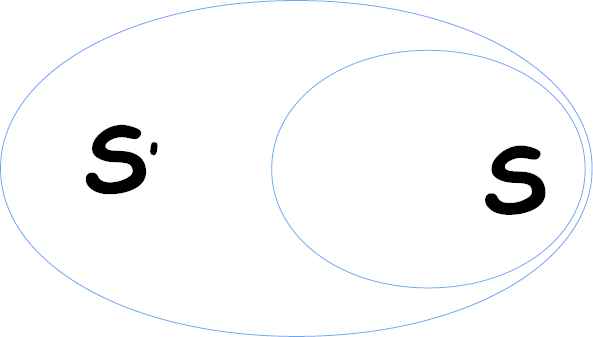
The dependence between the families S and S′ is clear:

S⊂S′,
as depicted in Figure 1.

Figure 1

Dependence between the families S and S′ of interval subsethood measures and strengthened interval subsethood measures, respectively.

Remark 6.

Observe that w(x)<w(y) (respectively, w(x)=w(y)) if and only if σ(y,y)<σ(x,x) (respectively, σ(y,y)=σ(x,x)).

Since (IM2') provides only the upper value of an interval, for the partial order ⩽LI, we may propose the following method to construct the lower value and, as a result, an example of a strengthened interval subsethood measure fulfilling axioms (IM1), (IM2'), (IM3) and (IM4) (Definition 7).

For x,y∈LI we set

r(x,y)=max{|x_−y_|,|x¯−y¯|}.

Observe that r(x,y)=r(y,x) in any case, and that x=y if and only if r(x,y)=0.

Theorem 3.

For x,y∈LI the operation σ:(LI)2→LI is a strengthened interval subsethood measure

σ_(x,y)=1−max(w(x),r(x,y)),
and
σ¯(x,y)=1,     x<LIy,1−r(x,y),otherwise.

Proof.

The map σ is well defined as in any case 0⩽σ_(x,y)⩽σ¯(x,y)⩽1.

(IM1) r(1,0)=1 and w(1)=0, hence σ(1,0)=0.

(IM2) Is satisfies by definition of operation σ.

(IM3) As r(x,x)=0 and so max(w(x),r(x,x))=w(x).

(IM4) Assume x⩽LIy⩽LIz, w(x)=w(y)=w(z):=w. Then we have

x_⩽y_⩽z_ and x¯⩽y¯⩽z¯. So z_−y_⩽z_−x_ and z¯−y¯⩽z¯−x¯, hence r(z,y)⩽r(z,x). Analogously r(y,x)⩽r(z,x). Therefore if x<LIy<LIz we have

σ(z,x)=[1−w,1−r(z,x)]⩽LI[1−w,1−r(z,y)]=σ(z,y),
and analogously σ(z,x)⩽LIσ(y,x). The case x=y=z is trivial and the cases x=y<LIz, respectively x<LIy=z, follow immediately taking in account that then we have σ¯(y,x)=1⩽σ¯(z,x), respectively σ¯(z,y)=1⩽σ¯(z,x).

Considering the construction from Theorem 3, we derive the following results.

Proposition 6.

Let σ∈S′ as in Theorem 3. For x,y∈LI, σ¯(x,y)=1 if and only if x⩽LIy.

Proposition 7.

Let σ∈S′ as in Theorem 3. For x,y∈LI the following are equivalent:

  1. σ_(x,y)=1,

  2. σ(x,y)=1,

  3. x=y and w(x)=0.

Proof.

As σ_(x,y)⩽σ¯(x,y) we have 1.⇔2. Further σ_(x,y)=1 is equivalent to w(x)=r(x,y)=0, that is to x=y and w(x)=0, and 1.⇔3.

Proposition 8.

Let σ∈S′ as in Theorem 3. For x,y∈LI, σ_(x,y)=0 if and only if either x=[0,1], or x=1 and y_=0, or y=1 and x_=0, or x=0 and y¯=1, or y=0 and x¯=1.

Proof.

As w(x)=1 if and only if x=[0,1], and r(x,y)=1 if and only if x=1 and y_=0, or y=1 and x_=0, or x=0 and y¯=1, or y=0 and x¯=1.

Proposition 9.

Let σ∈S′ as in Theorem 3. For x,y∈LI the following are equivalent:

  1. σ¯(x,y)=0,

  2. σ(x,y)=0,

  3. Either x=1 and y_=0, or y=0 and x¯=1.

Proof.

As above, 1.⇔2. Now by definition σ¯(x,y)=0 if and only if x≮y and r(x,y)=1, applying Proposition 8.

Let us now present some other construction methods for strengthened interval subsethood measures.

Theorem 4.

For x,y∈LI the operation σz′:(LI)2→LI is a strengthened interval subsethood measure

σz′(x,y)=[1−w(x),1],x⩽y,0,otherwise.

Proof.

Justification is analogous to Theorem 1.

Proposition 10.

Let ℬ:(LI)2→LI be an interval-valued aggregation function with respect to ⩽Adm such that ℬ⩽AdmAp. Then, σz′ is a ℬ-quasi-ordered operation (reflexive and ℬ-transitive with respect to ⩽Adm).

Proof.

Reflexivity is obvious by (IM3). We will prove ℬ-transitivity of σz′, that is,

ℬ(σz′(x,y),σz′(y,z))⩽Admσz′(x,z), x,y,z∈LI.

By ℬ⩽AdmAp (i.e., ℬ has element zero 0) we consider the following cases:

  1. If x⩽Admy⩽Admz, then

    ℬ(σz′(x,y),σz′(y,z))=ℬ([1−w(x),1],[1−w(y),1])   ⩽AdmAp([1−w(x),1],[1−w(y),1])  ⩽Adm[1−w(x),1]=σz′(x,z). 

  2. If y<Admx⩽Admz, then

    ℬ(σz′(x,y),σz′(y,z))=ℬ(0,[1−w(y),1])=0  ⩽Adm[1−w(x),1]=σz′(x,z). 

  3. If y⩽Admz<x, then

    ℬ(σz′(x,y),σz′(y,z))=ℬ(0,[1−w(y),1])=0  =σz′(x,z). 

    Similarly, the remaining 3 cases can be checked. As a result, σz′ is a ℬ-quasi-ordered operation.

Remark 7.

We may obtain a similar result to Proposition 10 considering the partial order ⩽LI, that is, ℬ-transitivity with respect to ⩽LI and ℬ⩽LIAp which is an interval-valued aggregation with respect to ⩽LI.

Theorem 5.

Let x,y∈LI and let the function σA:(LI)2→LI be given by

σA(x,y)=[1−w(x),1],x=y,[A1(n(x¯),y_),1],x<y,A(NIV(x),y),otherwise,
for an interval-valued fuzzy negation NIV such that
NIV(x)=[n(x¯),n(x_)]⩽[1−x¯,1−x_],
where n is a fuzzy negation and A is a representable interval-valued aggregation function with respect to ⩽ such that A=[A1,A2]⩽∨.

Thus, σA is a strengthened interval subsethood measure.

Proof.

Justification is similar to the one in Theorem 2.

Using the construction method given in Theorem 5 we obtain the following example.

Example 7.

Let us consider the partial order ⩽LI. The following is a strengthened interval subsethood measure:

σ(x,y)=[1−w(x),1],x=y,1−x¯+y_2,1,x<LIy,1−x¯+y_2,1−x_+y¯2,otherwise.

Theorem 6.

Let x,y∈LI and let the function σA:(LI)2→LI be given by

σA(x,y)=[1−max(w(x),r(x,y)),1],x⩽LIy,A(NIV(x),y),otherwise,
where NIV is an interval-valued fuzzy negation such that
NIV(x)=[n(x¯),n(x_)]⩽LI[1−x¯,1−x_],
where n is fuzzy negation and A is a representable interval-valued aggregation function with respect to the order ⩽LI, satisfying A=[A1,A2]⩽LI∨.

Thus, σA is a strengthened interval subsethood measure.

Proof.

Justification is analogous to Theorem 2.

Using the construction method given in Theorem 6 we get the following example.

Example 8.

Let us consider the partial order ⩽LI. The following is a strengthened interval subsethood measure

σ(x,y)=[1−max(w(x),r(x,y)),1],x⩽LIy,1−x¯+y_2,1−x_+y¯2,otherwise.

3.2. Connection between Interval-Valued Implication Functions and Subsethood Measures

Fuzzy implication operators are an example of functions that are used in many applications. In the literature, the definition of an implication in the interval-valued setting has been provided with respect to the partial order ⩽LI (cf. [40,45]), but note that it is possible to build interval-valued implication functions with respect to diverse orders. In [30], the definition and study of an interval-valued implication with respect to a total order was presented.

Definition 8.

An interval-valued fuzzy implication with respect to ⩽ is a function IIV:(LI)2→LI which verifies the following properties:

  1. IIV is a decreasing function in the first component and an increasing function in the second component with respect to the order ⩽,

  2. IIV(0,0)=IIV(1,1)=IIV(0,1)=1,

  3. IIV(1,0)=0.

We would like to point out the connection between interval-valued implication functions and the examined interval subsethood measures.

Remark 8.

Let x,y,z∈LI and w(x)=w(y)=w(z).

  • Let σ∈S. Then σ is an interval-valued implication function.

  • Let σ∈S′. Then σ is an interval-valued implication function if σ(0,1)=1.

We see that (IM1) implies σ(1,0)=0, (IM2) implies σ(0,1)=1 and (IM3) implies σ(0,0)=σ(1,1)=1 because w(x)=0. Moreover, by (IM4), we observe that σ is a decreasing function in the first component and an increasing function in the second component with respect to the order ⩽. Thus, σ∈S is an interval-valued implication function.

Condition (IM2'), the weaker version of (IM2), implies that we need to add the assumption σ(0,1)=1 to recover an interval-valued implication function from σ.

3.3. Subsethood Measures of Interval-Valued Fuzzy Sets

Subsethood measures may be also defined to give an estimation of “how included” an interval-valued set is in another.

We use the notion of interval-valued aggregation function to define subsethood measures and strengthened subsethood measures of interval-valued fuzzy sets.

Definition 9.

Let ℳ:(LI)n→LI be an interval-valued aggregation function and σ be an interval subsethood measure (respectively, a strengthened interval subsethood measure). The mapping σℳ:IVFS(U)×IVFS(U)→LI given by

σM(A,B)=M(σ(A(u1),B(u1)),…,σ(A(un),B(un))),
is a subsethood measure (respectively, a strengthened subsethood measure) on IVFS(U) defined by σ and ℳ.

Definition 9 presents the concept of subsethood measure (and strengthened subsethood measure) between interval-valued fuzzy sets providing a method for constructing such a measure from an interval subsethood measure (or a strengthened interval subsethood measure). In what follows, we present two theorems that describe the properties that a so-constructed subsethood measure between interval-valued fuzzy sets satisfy. Note that there is concordance between these properties and the ones of interval subsethood measures and strengthened interval subsethood measures in Section III. A. Additionally, the properties presented in the next theorems are in accordance with a possible axiomatic definition of subsethood measure for interval-valued fuzzy sets, which justifies Definition 9.

Given A∈IVFS(U), we use the following notation

w(A)=(w(a1),…,w(an)).

Moreover, 0,1:U→LI are defined by 0(ui)=0, 1(ui)=1 for each i=1,…,n.

Theorem 7.

Let U be a nonempty set such that card(U)=n∈ℕ and σℳ be a subsethood measure on IVFS(U) defined by an interval subsethood measure σ and an interval-valued aggregation function ℳ. Then, for A,B,C∈IVFS(U), the following hold:

  • (IMV1)

    σℳ(1,0)=0,

  • (IMV2)

    if A≺B, then σℳ(A,B)=1,

  • (IMV3)

    σℳ(A,A)=ℳ([1−w(A(u1)),1],…,[1−w(A(un)),1]),

  • (IMV4)

    if A≺_B≺_C and w(A)=w(B)=w(C), then σℳ(C,A)⩽σℳ(C,B) and σℳ(C,A)⩽σℳ(B,A).

Proof.

Let us set ai=A(ui), bi=B(ui), ci=C(ui), i=1,…,n.

  • (IMV1)

    By (IM1) we get

    σℳ(1,0)=ℳ(σ(1,0),…,σ(1,0))  =M(0,…,0)=0. 

  • (IMV2)

    Assume that A≺B, then ai<bi for i=1,…,n and, by (IM2), it holds that

    σℳ(A,B)=ℳ(σ(a1,b1),…,σ(an,bn))  =M(1,…,1)=1. 

  • (IMV3)

    It follows the fact that, by (IM3), we have σ(ai,ai)=[1−w(ai),1].

  • (IMV4)

    Assume that A≺_B≺_C and w(A)=w(B)=w(C). Then, it holds that ai⩽bi⩽ci and w(ai)=w(bi)=w(ci) for i=1,…,n. Thus, by (IM4),

    σℳ(C,A)=ℳ(σ(c1,a1),…,σ(cn,an))  ⩽ℳ(σ(c1,b1),…,σ(cn,bn))  =σℳ(C,B). 

    Similarly, it can be shown that σℳ(C,A)⩽σℳ(B,A), which proves (IMV4).

Theorem 8.

Let U be a nonempty set such that card(U)=n∈ℕ and σℳ be a strengthened subsethood measure on IVFS(U) defined by a strengthened interval subsethood measure σ and a representable interval-valued aggregation function ℳ=[M1,M2]. Then, for A,B,C∈IVFS(U), conditions (IMV1), (IMV3), (IMV4) are fulfilled. Moreover, the following condition holds:

  • (IMV2')

    A≺B, then σℳ¯(A,B)=1.

Proof.

By Theorem 7, it suffices to show (IMV2'). Setting ai=A(ui) and bi=B(ui) for i=1,…,n, we have that if A≺B, then ai<bi for i=1,…,n. Consequently, by (IM2'), it holds that

σℳ¯(A,B)=M2(σ¯(a1,b1),…,σ¯(an,bn))  =M2(1,…,1)=1. 

As we can observe by Theorems 7 and 8 the subsethood measures or the strengthened subsethood measure have similar properties to their corresponding generators, or interval subsethood measures.

4. CONCLUSIONS

In this paper, we have discussed two possible axiomatical definitions of interval subsethood measures for the interval-valued fuzzy setting taking into account the widths of the intervals involved. Specifically, we have introduced interval subsethood measures (Definition 6) and strengthened interval subsethodd measures (Definition 7). The relationships among the proposed subsethood measures of intervals have been examined.

Since the inclusion of the width of intervals has been proven to be useful in image processing [26,27] and so have fuzzy subsethood measures [19], our plan for future works is to apply the introduced subsethood measures in constructions of width-based indistinguishability measures and to use them in image processing problems.

CONFLICT OF INTEREST

The authors declare no conflict of interests.

AUTHORS' CONTRIBUTIONS

Barbara Pekala, Urszula Bentkowska and Mikel Sesma-Sara developed the main mathematical results and were in charge of writing. Javier Fernandez, Julio Lafuente and Humberto Bustince conceived the idea and developed some of the theoretical results. Abdulrahman Altalhi, Maksymilian Knap and Jesús M. Pintor checked the correctness of the theory and the writing.

ACKNOWLEDGMENTS

This work was partially supported by the Centre for Innovation and Transfer of Natural Sciences and Engineering Knowledge of University of Rzeszów, Poland, the project RPPK.01.03.00-18-001/10. Moreover, Urszula Bentkowska acknowledges the support of the Polish National Science Centre grant number 2018/02/X/ST6/00214. Mikel Sesma-Sara, Javier Fernandez and Humberto Bustince were partially supported by Research project TIN2016-77356-P(AEI/UE/FEDER) of the Spanish Government.

REFERENCES

22.R. Sambuc, Fonctions ϕ-floues: application á l'aide au diagnostic en pathologie thyroidienne, Université de Marseille, France, 1975. Ph.D. Thesis (in French)
38.J. Aczél, Lectures on Functional Equations and their Applications, Academic Press, New York, London, 1966.
Journal
International Journal of Computational Intelligence Systems
Volume-Issue
13 - 1
Pages
167 - 177
Publication Date
2020/02/12
ISSN (Online)
1875-6883
ISSN (Print)
1875-6891
DOI
10.2991/ijcis.d.200204.001How to use a DOI?
Copyright
© 2020 The Authors. Published by Atlantis Press SARL.
Open Access
This is an open access article distributed under the CC BY-NC 4.0 license (http://creativecommons.org/licenses/by-nc/4.0/).

Cite this article

TY  - JOUR
AU  - Barbara Pękala
AU  - Urszula Bentkowska
AU  - Mikel Sesma-Sara
AU  - Javier Fernandez
AU  - Julio Lafuente
AU  - Abdulrahman Altalhi
AU  - Maksymilian Knap
AU  - Humberto Bustince
AU  - Jesús M. Pintor
PY  - 2020
DA  - 2020/02/12
TI  - Interval Subsethood Measures with Respect to Uncertainty for the Interval-Valued Fuzzy Setting
JO  - International Journal of Computational Intelligence Systems
SP  - 167
EP  - 177
VL  - 13
IS  - 1
SN  - 1875-6883
UR  - https://doi.org/10.2991/ijcis.d.200204.001
DO  - 10.2991/ijcis.d.200204.001
ID  - Pękala2020
ER  -