International Journal of Computational Intelligence Systems

Volume 13, Issue 1, 2020, Pages 954 - 965

Group-Like Uninorms

Authors
Sándor Jenei*, ORCID
University of Pécs, Pécs, Hungary
Corresponding Author
Sándor Jenei
Received 14 November 2019, Accepted 26 June 2020, Available Online 17 July 2020.
DOI
10.2991/ijcis.d.200706.001How to use a DOI?
Keywords
Uninorms; Construction; Characterization
Abstract

Uninorms play a prominent role both in the theory and the applications of aggregations and fuzzy logic. In this paper a class of uninorms, called group-like uninorms will be introduced and a complete structural description will be given for a large subclass of them. First, the four versions of a general construction—called partial lex product—will be recalled. Then two particular variants of them will be specified: the first variant constructs, starting from ℝ (the additive group of the reals) and modifying it in some way by ℤ's (the additive group of the integers) what we will coin basic group-like uninorms, whereas the second variant can enlarge any group-like uninorm by a basic group-like uninorm resulting in another group-like uninorm. All group-like uninorms obtained this way are “square” and have finitely many idempotent elements. On the other hand, we prove that any square group-like uninorm which has finitely many idempotent elements can be constructed by consecutive applications of the second variant (finitely many times) using only basic group-like uninorms as building blocks. Any basic group-like uninorm can be built by the first variant using only ℝ and ℤ, and any square group-like uninorm which has finitely many idempotent elements can be built using the second variant using only basic group-like uninorms: ultimately, all such uninorms can be built from ℝ and ℤ. In this way a complete characterization for square group-like uninorms which possess finitely many idempotent elements is given. The characterization provides, for potential applications in several fields of fuzzy theory or aggregation theory, the whole spectrum of choice of those square group-like uninorms which possess finitely many idempotent elements.

Copyright
© 2020 The Authors. Published by Atlantis Press SARL.
Open Access
This is an open access article distributed under the CC BY-NC 4.0 license (http://creativecommons.org/licenses/by-nc/4.0/).

1. INTRODUCTION

Aggregation operations are crucial in numerous pure and applied fields of mathematics. Fuzzy theory is another large field, involving both pure mathematics and an impressive range of applications. Mathematical fuzzy logics have been introduced in [1], and the topic is a rapidly growing field ever since. In all these fields (and the list is far from being exhaustive) a crucial role is played by t-norms, t-conorms, and uninorms [2].

Establishing the structure theory of the whole class of uninorms seems to be quite difficult and out of reach. Several authors have characterized particular subclasses of them, see, e.g., [3–11]. Uninorms are interesting not only for a structural description purpose, but also different generalizations of them play a central role in many studies, see [12,13] for example. Group-like uninorms, to be introduced below, form a subclass of involutive uninorms, and involutive uninorms play the same role among uninorms as the Łukasiewicz t-norm or in general, the class of rotation-invariant t-norms [14–18] do in the class of t-norms. Because of the wide range of theoretical and practical applications of rotation-invariant t-norms, and also only the Łukasiewicz t-norm, it can be expected that involutive uninorms will find an increasing number of applications, too. Giving an effective description for the structure of the whole class of involutive uninorms seems to be extremely complicated and far beyond the present advance of algebra. In this paper we shall give a complete characterization for a large and rich subclass, the class of square group-like uninorms which have finitely many idempotent elements.

Residuation is a crucial property in mathematical fuzzy logics and in substructural logics, in general [19,20]. Replacing the usual universe [0,1] of a (residuated) involutive uninorm by an arbitrary linearly ordered set leads to the algebraic notion of involutive FL e-chains (another standard terminology for this class of algebras is pointed involutive commutative residuated chains). Group-like uninorms will be defined as a particular subclass of involutive uninorms such that replacing their universe by an arbitrary linearly ordered set leads to the general notion of odd involutive FL e-chains: group-like uninorms are the monoidal operations of odd involutive FL e-chains over [0,1].

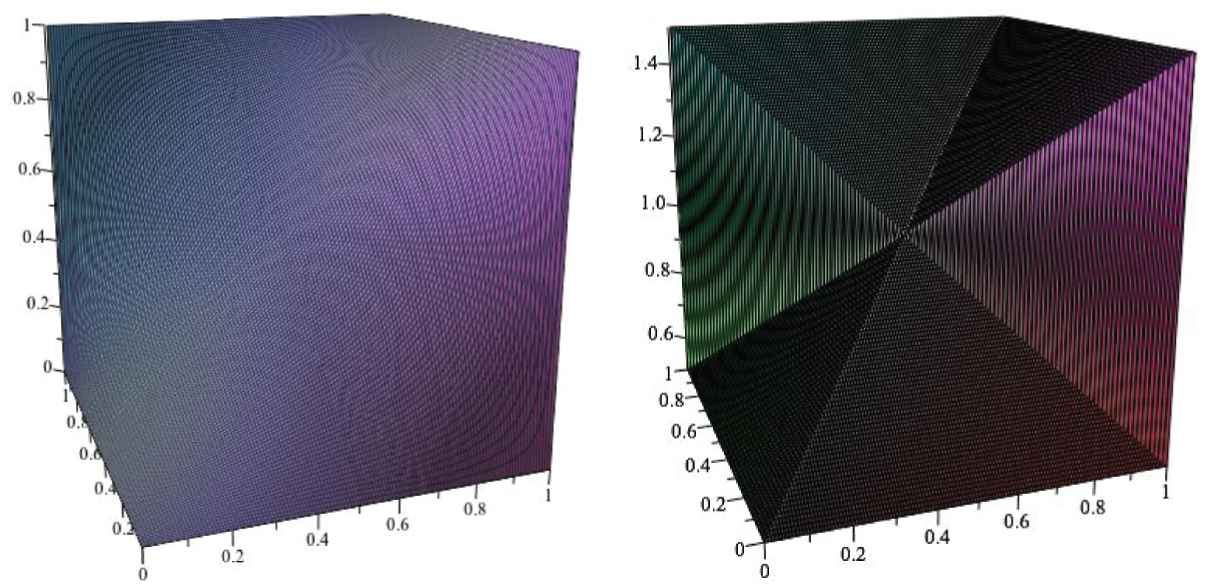
The literature of FL e-algebras (aka. pointed commutative residuated lattices) is very rich, the main reason of which is that residuated lattices are algebraic counterparts of a vast class of logics, called substructural logic, see [19] and the references therein. Involutive FL e-algebras (aka. involutive pointed commutative residuated lattices) correspond to substructural logics which satisfy the double negation axiom ¬¬φ↔φ. Bounded involutive FL e-chains correspond to IUL (Involutive uninorm logic) [20], whereas bounded odd involutive FL e-chains correspond to IULfp (Involutive uninorm logic with fixed point) [21,22]. This provides another source of interest for group-like uninorms, being the standard (i.e., [0,1]-valued) semantics for IULfp. Prominent examples of odd involutive FL e-algebras are lattice-ordered abelian groups and odd Sugihara monoids (see Figure 1 for an example, each), the former constitutes an algebraic semantics of Abelian logic [23, 24], and the latter constitutes an algebraic semantics of a logic at the intersection of relevance logic and fuzzy logic [25]. The above-mentioned two examples are extremal in the sense that as opposed to integral structures where the unit element is the largest one and its residual complement is the least one, the unit element (and also its residual complement) is “in the middle.” These two examples are also extremal in the sense that lattice-ordered abelian groups have a single idempotent element, namely the unit element, whereas all elements of any odd Sugihara monoid are idempotent.

Figure 1

Visualization: the graph of the only linearly ordered abelian group over ]0; 1[ (left) and the graph of the only odd Sugihara monoid over ]0; 1[ (right).

In order to narrow the gap between these two extremal classes, in [26,27] a deep knowledge has been gained about the structure of odd involutive FL e-chains, including a Hahn-type embedding theorem and a representation theorem by means of linearly ordered abelian groups and there-introduced constructions, called partial lex products [27] and the more general partial sublex products [26]: all odd involutive FL e-chains which have finitely many idempotent elements have a partial sublex product group-representation. Square odd involutive FL e-algebras are those which admit a partial lex product group-representation. Representability by partial lex products has a key role in the present paper. The consequence of the main result of [26,27] to [0,1]-valued algebras is that all group-like uninorms which possess finitely many idempotent elements admit a partial sublex product group-representation. Square group-like uninorms are defined as those group-like uninorms which admit a partial lex product group-representation. What we show in this paper is, roughly, that square group-like uninorms can be built from very specific linearly ordered abelian groups: ℤ and ℝ. First, we adapt the partial lex product construction to the narrower, more specific setting of group-like uninorms by introducing two particular variants of it. These variants use only ℝ and ℤ, the additive group of real numbers and integers, respectively. With these two variants one can construct group-like uninorms having finitely many idempotent elements. Our main theorem asserts that all square group-like uninorms having finitely many idempotent elements can be constructed by using these two variants. Ultimately, it follows that all these uninorms can be constructed by the partial lex product construction from only ℝ and ℤ. The price to be paid for describing such a rich class of operations by such simple and well understood building blocks is that the partial lex product construction (even in its more restricted two variants form) will be quite complex. Another interpretation of the same result is that all these uninorms can be built by the second variant of the partial lex product construction using only basic group-like uninorms. If understood this way then there is a striking similarity between this characterization and the well-known ordinal sum representation of continuous t-norms of Mostert and Shields as ordinal sums of continuous archimedean t-norms [28]: replace “t-norm” by “uninorm,” “continuous” by “square group-like with finitely many idempotent elements,” “continuous archimedean t-norm” by “basic group-like uninorm,” and “ordinal sum construction” by “the second variant of the partial lex product construction.” Besides, according to the classification of continuous archimedean t-norms, any continuous archimedean t-norm is order isomorphic to either the Łukasiewicz t-norm or the Product t-norm, so there are two prototypes. In our setting basic group-like uninorms have ℵ0 prototypes, one for each natural number.

2. PRELIMINARIES

Introduced in [29], a uninorm U is a function of type [0,1]×[0,1]→[0,1] (i.e., a binary operation over the closed real unit interval [0,1]) such that the following axioms are satisfied.

U(x,y)=U(y,x)(Commutativity)If y≤z then U(x,y)≤U(x,z)(Monotonicity)U(U(x,y),z)=U(x,U(y,z))(Associativity)There exists t∈]0,1[such that U(x,t)=x(Unit Element) 

A uninorm is residuated if there exists a function IU of type [0,1]×[0,1]→[0,1] (i.e., a binary operation on [0,1]) such that the following is satisfied: U(x,y)≤z if and only if IU(x,z)≥y. Frequently one uses the infix notation for uninorms, too, and writes x⊛y instead of U(x,y), and x→⊛y instead of IT(x,y). A generalization of residuated t-norms and uninorms is the notion of FL e-algebras. This generalization is done by replacing [0,1] by an arbitrary lattice, possibly without top and bottom elements.

Throughout the paper algebras will be denoted by bold capital letters, their underlying sets by the same regular letter.

Definition 1.

An FL e-algebra1 is a structure X=(X,∧,∨,⊛,→⊛,t,f) such that (X,∧,∨) is a lattice (X,≤,⊛,t) is a commutative, residuated, monoid, and f is an arbitrary constant, where being residuated means that there exists a binary operation →⊛ such that x⊛y≤z if and only if x→⊛z≥y. This equivalence is often called adjointness condition (⊛,→⊛) is called an adjoint pair. Equivalently, for any x,z, the set {v|x⊛v≤z} has its greatest element, and x→⊛z is defined as this element: x→⊛z:=max{v|x⊛v≤z}; this is often referred to as the residuation property. One defines x′=x→⊛f and calls an FL e-algebra (and also its monoidal operation) involutive if (x′)′=x holds. The rank of an involutive FL e-algebra is positive if t>f, negative if t<f, and 0 if t=f. An involutive FL e-algebra is called odd if it is of rank 0. For an odd involutive FL e-algebra X, let Xgr be the set of invertible elements of X. It turns out that there is a subalgebra of X on Xgr, denote it by Xgr and call it the group part of X. We say that two consecutive elements x≤y in X form a gap in X if x≤z≤y implies z=x or z=y. In an FL e-algebra call an element positive it it is greater or equal to the unit element, and strictly negative if it is smaller than the unit element.

Speaking in algebraic terms, t-norms and uninorms are the monoidal operations of commutative linearly ordered monoids over [0,1]. Likewise, residuated t-norms and uninorms are just the monoidal operations of FL e-algebras over [0,1]. According to the terminology above, the class of involutive t-norms constitutes the Łukasiewicz t-norm, and all rotation-invariant t-norms (aka. monoidal operations of IMTL-algebras over [0,1]) in general.

Definition 2.

We call the monoidal operation ⊛ of an odd involutive FL e-algebra over the real unit interval [0,1] a group-like uninorm.

We know more about the behavior of group-like uninorms (and of monoidal operations of bounded odd involutive FL e-algebras, in general) in the boundary, as it holds true that

U(x,y)=∈]0,1[ if x,y∈]0,1[0 if min(x,y)=01 if x,y>0 and max(x,y)=1.

Therefore, values of a group-like uninorm U in the open unit square ]0,1[2 fully determine U. As a consequence, one can view group-like uninorms as binary operations on ]0,1[, too. Because of this observation, throughout the paper we shall use the term group-like uninorm in a slightly different manner: instead of requiring the underlying universe to be [0,1], we only require that the underlying universe is order isomorphic to the open unit interval ]0,1[. This way, e.g., the usual addition of real numbers, that is letting V(x,y)=x+y, becomes a group-like uninorm in our terminology. This is witnessed by any order isomorphism from ]0,1[ to ℝ, take for instance φ(x)=tan(πx−π2). Using φ, any group-like uninorm (on ℝ, for example) can be carried over to [0,1] by letting, in our example,

U(x,y)=φ−1(V(φ(x),φ(y))) if x,y∈]0,1[0 if min(x,y)=01 if x,y≠0 and max(x,y)=1.

Since ]0,1[ and ℝ are order isomorphic, technically, when proving that an operation is a group-like uninorm, we shall prove that its underlying set is order isomorphic to ℝ. Therefore, throughout the paper Theorem A below will play an important technical role.

Definition 3.

A linearly ordered set (X,≤) is called Dedekind complete if every nonempty subset of X bounded from above by an element of X has a supremum in X. (X,≤) is called densely ordered if for any x,y∈X such that x<y there exists z∈X such that x<z<y. A subset Y of X is called dense (in X) if any nonempty open interval in X contains an element from Y.

Theorem A.

([30], Theorem 2.29) A linearly ordered set (K,≤) is order isomorphic to the set of real numbers if and only if (K,≤) possesses the following four properties:

  1. (K,≤) has no least neither greatest element,

  2. (K,≤) is densely ordered,

  3. there exists a countable dense subset of (K,≤), and

  4. (K,≤) is Dedekind complete.

In the sequel we shall use this theorem in proving order isomorphism to ℝ without further mention, and if the underlying sets of two odd involutive FL e-chains X and Y are order isomorphic then we denote it by X≅oY.

Definition 4.

For a chain (a linearly ordered set) (X,≤) and for x∈X define the predecessor x↓ of x to be the maximal element of the set of elements which are smaller than x, if it exists, define x↓=x otherwise. Define the successor x↑ of x dually. We say for Z⊆X that Z is discretely embedded into X if for x∈Z it holds true that x∉{x↑,x↓}⊆Z.

Nontrivial Dedekind complete linearly ordered abelian groups are widely-known to be isomorphic to either ℤ or ℝ. Since linearly ordered abelian groups are exactly cancellative odd involutive FL e-chains [27], often we shall view ℝ and ℤ as odd involutive FL e-chains, and speak about an involutive FL e-chain induced by a linearly ordered abelian group. Since an isomorphism between linearly ordered abelian groups naturally extends to the induced FL e-algebras, the following lemma follows in a straightforward manner.

Lemma A.

For any abelian group G, if G≅oℝ then (qua FL e-algebras) G≅ℝ. Any linearly ordered abelian group G which is Dedekind complete and satisfies x↓<x<x↑ is isomorphic (qua an FL e-algebra) to ℤ.

The rest of this chapter is cited from [26,27].

Definition 5.

The lexicographic product of two linearly ordered sets A=(A,≤1) and B=(B,≤2) is a linearly order set A×→B=(A×B,≤), where A×B is the Cartesian product of A and B, and ≤ is defined by 〈a1,b1〉≤〈a2,b2〉 if and only if a1<1a2 or a1=a2 and b1≤1b2. The lexicographic product A×→B of two FL e-chains A and B is an FL e-chain over the lexicographic product of their respective universes such that all operations are defined coordinatewise.

We shall view such a lexicographic product as an enlargement: each element in A is replaced by a whole copy of B. Accordingly, in Definition 6 by a partial lex product of two linearly ordered sets we will mean a kind of partial enlargement: only some elements of the first algebra will be replaced by a whole copy of the second algebra.

The partial lex product construction will be crucial for our purposes.

Definition 6.

Let X=(X,∧X,∨X,∗,→∗,tX,fX) be an odd involutive FL e-algebra and Y=(Y,∧Y,∨Y,⋆,→⋆,tY,fY) be an involutive FL e-algebra, with residual complement  ′  ∗ and  ′  ⋆, respectively.

  1. Add a new element ⊤ to Y as a top element and annihilator (for ⋆), then add a new element ⊥ to Y∪{⊤} as a bottom element and annihilator. Extend  ′  ⋆ by ⊥′  ⋆=⊤ and ⊤′  ⋆=⊥. Let V≤Z≤Xgr. Let

    XZV×↠Y=(V×Y)∪(Z×{⊤})∪X×{⊥}
    and define XZV×↠Y, the type III partial lexicographic product of X,Z,V and Y as follows:
    XZV×↠Y=XZV×↠Y,≤,⊛,→⊛,(tX,tY),(fX,fY),
    where ≤ is the restriction of the lexicographical order of ≤X and ≤Y∪{⊤,⊥} to XZV×↠Y, ⊛ is defined coordinatewise, and the operation →⊛ is given by (x1,y1)→⊛(x2,y2)=(x1,y1)⊛(x2,y2)′′, where
    (x,y)′=(x′  ∗,⊥)if x∉Z(x′  ∗,y′  ⋆)if x∈Z.

    In the particular case when V=Z, we use the simpler notation XZ×↠Y for XZV×↠Y and call it the type I partial lexicographic product of X,Z, and Y.

  2. Assume that Xgr is discretely embedded into X. Add a new element ⊤ to Y as a top element and annihilator. Let V≤Xgr. Let

    XV×⇀→Y=(V×Y)∪(X×{⊤})
    and define XV×⇀→Y, the type IV partial lexicographic product of X, V and Y as follows:
    XV×⇀→Y=XV×⇀→Y,≤,⊛,→⊛,(tX,tY),(fX,fY),
    where ≤ is the restriction of the lexicographical order of ≤X and ≤Y∪{⊤} to XV×⇀→Y, ⊛ is defined coordinatewise, and the operation →⊛ is given by (x1,y1)→⊛(x2,y2)=(x1,y1)⊛(x2,y2)′′, where  ′ is defined coordinatewise2 by
    (x,y)′=(x′  ∗,⊤)if x∉Xgr and y=⊤((x′  ∗)↓,⊤)if x∈Xgr and y=⊤(x′  ∗,y′  ⋆)if x∈V and y∈Y .(1)

    In the particular case when V=Xgr, we use the simpler notation X×⇀→Y for XV×⇀→Y and call it the type II partial lexicographic product of X and Y.

    A 3D plot of a type I extension is in Figure 3, and a 3D plot of a type II extension is in Figure 2 (right)
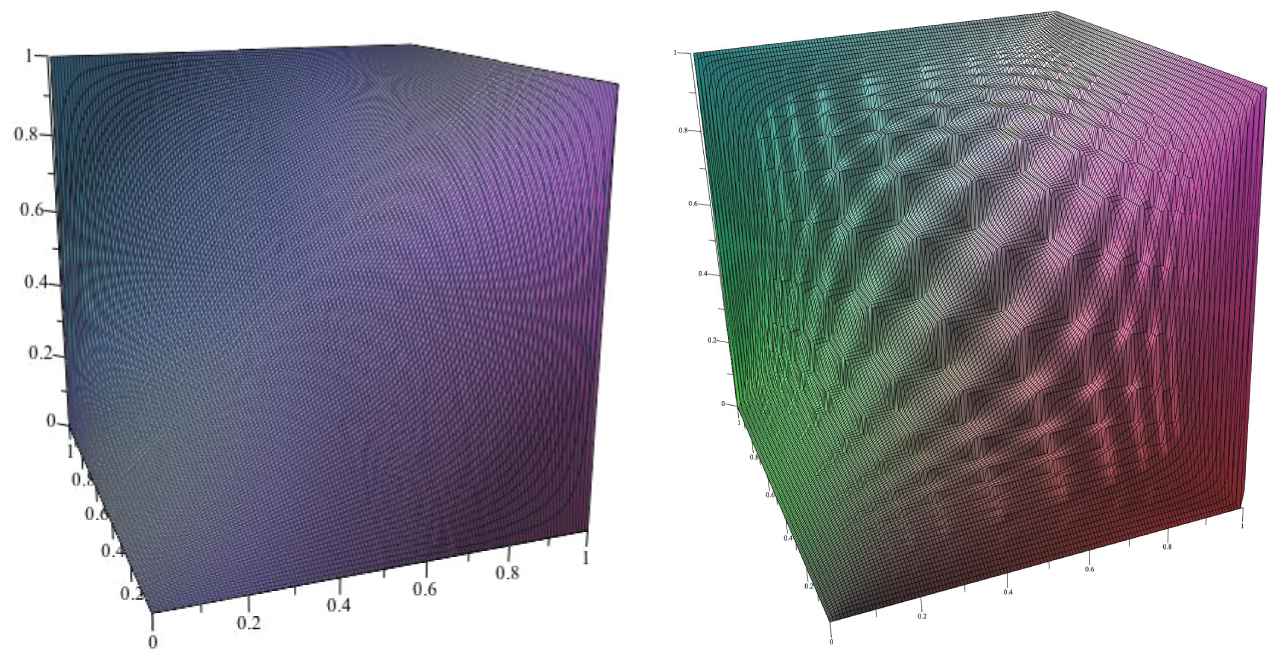
Figure 2

Visualization: the graphs of two basic group-like uninorms, U0=ℝ and U1=ℤ×⇀→ℝ shrank into ]0; 1[. One can describe U1 as infinitely many U0 components. Imagine U2 in the same way: as infinitely many U1 components, etc.
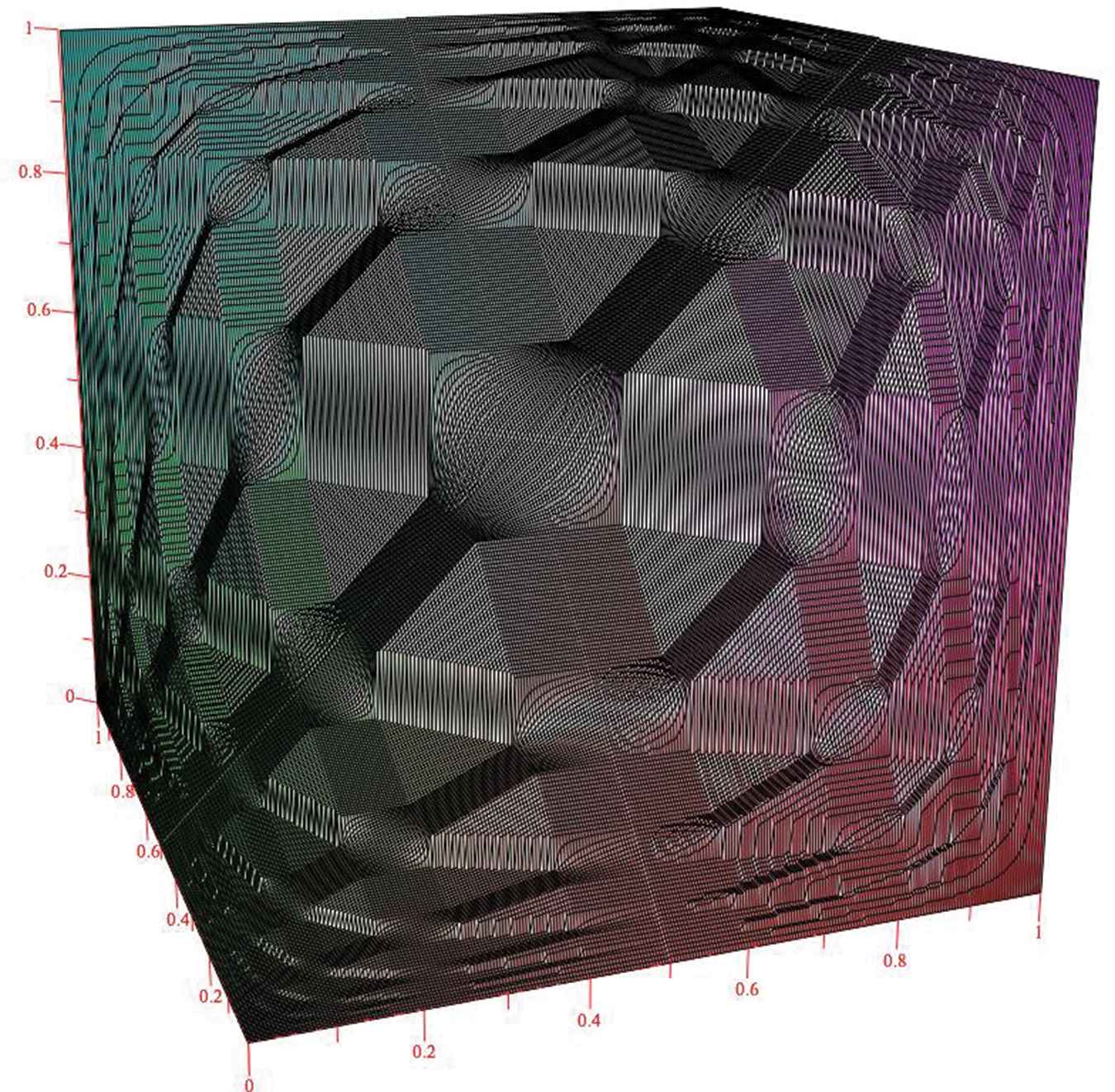
Figure 3

Visualization: an example for a type I extension, RZ×↠⁡R shrank into ]0; 1[

Theorem 1.

Adapt the notation of Definition 6. XZV×↠Y and XV×⇀→Y are involutive FLe-algebras with the same rank as that of Y. In particular, if Y is odd then so are XZV×↠Y and XV×⇀→Y. In addition, XZV×↠Y≤XZ×↠Y and XV×⇀→Y≤X×⇀→Y.

Definition 7.

We introduce the following notation. Let A1, A2,…,An and D be FL e-algebras, and let D≤A1×→A2. If ν, the projection operation to the first coordinate maps D onto A1, i.e., if ν(D)={a1∈A1:there exists(a1,a2)∈D}=A1 then we denote it by

D≤νA1×→A2.

Definition 8.

Adapt the notation of Definition 6. Let A=XZV×↠Y and B=XV×⇀→Y. Then A=(V×Y)∪(Z×{⊤})∪X×{⊥}, B=(V×Y)∪(X×{⊤}), and the group part Agr of A, as well as the group part Bgr of B is the group V×→Ygr, which is the subalgebra of A and of B over V×Ygr in both cases. Let

H≤νV×→Ygr.(2)

Replace Agr in A and Bgr in B by H to obtain AH and BH, respectively. More formally, let

AH=H∪(V×(Y∖Ygr)∪(Z×{⊤})∪X×{⊥},
BH=H∪(V×(Y∖Ygr))∪(X×{⊤}).

Then AH and BH are closed under all operations of A and B, respectively, and hence AH is a subalgebra of A, and BH is a subalgebra of B. Call them the partial sublex product of their respective algebras (like in Definition 6) and H.

A half-line proof shows (see [27, Section 2]) that in any odd involutive FL e-chain (in particular, in any group-like uninorm) the residual complement of any negative idempotent element is a positive idempotent element. Therefore, for a group-like uninorm, having finitely many idempotent elements is equivalent to having finitely many positive idempotent elements. The main motivating theorem of the present paper asserts that up to isomorphism, any odd involutive FL e-chain which has only finitely many positive idempotent elements can be built by iterating finitely many times the type I and type II partial sublex product constructions using only linearly ordered abelian groups as building blocks. We will refer to this fact as follows: every odd involutive FL e-chain (in particular, any group-like uninorm algebra) which has only finitely many positive idempotent elements has a partial sublex product group-representation.

Theorem 2.

[26, 27] If X is an odd involutive FLe-chain, which has only n∈ℕ, n≥1 positive idempotent elements then it has a partial sublex product group representation, i.e., for i=2,…,n there exist totally ordered abelian groups H1, Hi, Gi, Zi−1, Vi−1 along with ιi∈{I,II} such that X≅Xn, where for i∈{2,…,n},

X1=H1 and Xi=Xi−1Zi−1Vi−1×↠GiHiif ιi=IXi−1Vi−1×⇀→GiHiif ιi=II.

Notice that Theorem 2 claims isomorphism between X and Xn hence Xn and consequently for i=n−1,…,2, the Xi's are claimed implicitly to exist (to be well defined). Hence, by Definitions 6 and 8, using that (Xi)gr=Hi holds for i∈{1,…,n}, it is necessarily that

for i=2,…,n,Zi−1≤Hi−1,Hi≤Zi−1×→Gi and for i=2,…,n, if ιi=II then Hi−1 is discretely embedded into Xi−1.

As said before, by Theorem 2 all odd involutive FL e-chains with finitely many positive idempotent elements (in particular, all group-like uninorm algebras with finitely many positive idempotent elements) have a partial sublex product group-representation. We define a subclass of them in Definition 9. Recall that by definition a type III partial lex product is a particular instance of a type I partial sublex product. For instance, Xi−1Zi−1Vi−1×↠Gi is a particular instance of Xi−1Zi−1Vi−1×↠GiHi where Hi=Vi−1×→Gi.

Definition 9.

An odd involutive FL e-chain X is called square it it possesses a partial lex product group-representation. More formally, if for i=2,…,n there exist linearly ordered abelian groups H1, Gi, Zi−1, Vi−1 along with ιi∈{I,II} such that X≅Xn, where for i∈{2,…,n},

X1=H1 and Xi=Xi−1Zi−1Vi−1×↠Giif ιi=IXi−1Vi−1×⇀→Giif ιi=II .

Like in Theorem 2, Definition 9 asserts isomorphism between X and Xn hence Xn and consequently for i=n−1,…,2, the Xi's are claimed implicitly to exist. By Definition 6, using that (Xi)gr=Vi−1×→Gi holds for i∈{2,…,n}, it is necessarily that (by letting V0 be the trivial group)

for i=2,…,n,Zi−1=Vi−2×→Gi−1,Vi−1=Zi−1 and for i=2,…,n,if ιi=II then Vi−2×→Gi−1 is discretelyembedded in to Xi−1.

We call a group-like uninorm square if its induced odd involutive FL e-chain is square.

3. STRUCTURAL DESCRIPTION

The characterization theorem for square group-like uninorms in Theorem 3 will be achieved via a series of lemmas.

3.1. Groupping Extensions Together

The proofs in this section do not require much more than tedious verification using the rather complex Definition 6. First we show that two (and thus also finitely many) consecutive type II extensions can be replaced by a single type II extension. More formally, we claim that

Lemma 1.

For any odd involutive FL e-algebras A, B, C, it holds true that

(A×⇀→B)×⇀→C≅A×⇀→(B×⇀→C),
i.e., if the algebra on one side is well-defined3 then the algebra on the other side is well-defined, too, and the two algebras are isomorphic.

Proof.

By Definition 6, the universe of A×⇀→B is (Agr×B)∪(A×{⊤}), and hence the universe of (A×⇀→B)gr is Agr×Bgr. Therefore, the universe of (A×⇀→B)×⇀→C is (Agr×Bgr×C)∪(Agr×B×{⊤})∪(A×{⊤}×{⊤}). On the other hand, the universe of B×⇀→C is (Bgr×C)∪(B×{⊤}). Therefore, by denoting (⊤,⊤) the new top element added to B×⇀→C, the universe of A×⇀→(B×⇀→C) is (Agr×Bgr×C)∪(Agr×B×{⊤})∪(A×{⊤}×{⊤}), so the underlying universes of (A×⇀→B)×⇀→C and A×⇀→(B×⇀→C) coincide. Clearly, the unit elements are the same. Since the monoidal operation of a type II extension is defined coordinatewise, the respective monoidal operations coincide, too. Since both algebras are residuated, and the monoidal operation and the universe uniquely determine the residual operation, it follows that the residual operations coincide, too, hence so do the residual complement operations.

Finally, the left-hand side is well-defined if and only if Agr is discretely embedded into A, and Agr×Bgr is discretely embedded into (Agr×B)∪(A×{⊤}). It cannot be the case that |Bgr|=1, since then for a∈Agr, (a,1B)∈Agr×Bgr but (a,1B)↑=(a,⊤)∉Agr×Bgr. Therefore |Bgr|=∞, and hence, using that Agr×Bgr is discretely embedded into (Agr×B)∪(A×{⊤}), it follows that Bgr is discretely embedded into B. Thus B×⇀→C and also the right-hand side is well-defined, too. On the other hand, the right-hand side is well-defined if and only if Agr is discretely embedded into A, and Bgr is discretely embedded into B. But then clearly Agr×Bgr is discretely embedded into (Agr×B)∪(A×{⊤}), and hence the left-hand side is well-defined, too.

Next we show that a type I partial lex extension followed by a type II partial lex extension can be replaced by a single type I partial lex extension. More formally, we claim that

Lemma 2.

For any odd involutive FL e-algebras A, H, L, B, such that H≤Agr, it holds true that

(AH×↠L)×⇀→B≅AH×↠(L×⇀→B)
i.e., if the algebra on one side is well-defined then the algebra on the other side is well-defined, too, and the two algebras are isomorphic.

Proof.

For both sides to be well-defined, H≤Agr is needed.

That apart, the left-hand side is well-defined if and only if the group part of AH×↠L is discretely embedded into the universe of AH×↠L, i.e., if and only if

  1. H×Lgr is discretely embedded into (H×L)∪(H×{⊤L})∪(A×{⊥L}),

    and the right-hand side is well-defined if and only if

  2. Lgr is discretely embedded into L.

Clearly, (ii) implies (i). Now, assume (i). Then Lgr cannot be finite. Indeed, if Lgr were finite then by taking its largest element l∈Lgr, the element (1H,l)↑ must be greater than (1H,l) since H×Lgr is discretely embedded. Therefore, (1H,l)↑ is either equal to (1H,l↑) which is not in H×Lgr since l was chosen to be the greatest element in Lgr, or equal to (1H,⊤) which is not in H×Lgr either. Hence Lgr is infinite, and therefore for any (h,l)∈H×Lgr it holds true that (h,l)↑=(h,l↑)∈H×Lgr and (h,l)↓=(h,l↓)∈H×Lgr, that is, (ii) holds.

Denote C=AH×↠L for short. As we have seen above, C=(H×L)∪(H×{⊤L})∪(A×{⊥L}), and Cgr=H×Lgr. Therefore, the universe of (AH×↠L)×⇀→B is

(Cgr×B)∪(C×{⊤B})=(H×Lgr×B)∪(H×L×{⊤B})∪(H×{⊤L}×{⊤B})∪(A×{⊥L}×{⊤B})

On the other hand, the universe of L×⇀→B is (Lgr×B)∪(L×{⊤B}). Let ⊤L, ⊥L, and ⊤B be the new top, bottom, and top element added to L, L, and B, respectively, according to Definition 6. Then it is easily verified that (⊤L,⊤B) and (⊥L,⊤B) satisfy the requirements of Definition 6 to be the new top and bottom elements of L×⇀→B. Hence the universe of AH×↠(L×⇀→B) is

(H×Lgr×B)∪(H×L×{⊤ })∪(H×{⊤ }×{⊤ })∪(A×{⊥ }×{⊤ })
so the underlying universes of the two algebras coincide.

Clearly, the unit elements are the same. Since the monoidal operation of a partial lex product is defined coordinatewise, the respective monoidal operations coincide, too. Since both algebras are residuated and the monoidal operation and the universe uniquely determines its residual operation, it follows that the residual operations coincide, too, hence so do the residual complements.

3.2. When Do Partial Lex Extensions ≅oℝ?

It is apparent from Definition 6 that type I and type II lex extensions are simpler particular instances of type III and type IV lex extension, respectively. First we show that all the extensions in the group-representation of a square group-like uninorm must be type I or II; otherwise the constructed algebra cannot be ≅oℝ.

Lemma 3.

The following statements hold true.

  1. Any type III lex extension which is not of type I has a gap outside its group part.

  2. Any type IV lex extension which is not of type II has a gap outside its group part.

  3. If an odd involutive FL e-algebra has a gap outside its group part then any type III lex extension of it has a gap outside its group part, too.

  4. If an odd involutive FL e-algebra has a gap outside its group part then any type IV lex extension of it has a gap outside its group part, too.

Proof.

The statements are direct consequences of the definition of partial lex products:

  1. Consider AHK×↠B, where H∖K≠∅. For any a∈H∖K it holds true that (a,⊥)<(a,⊤) is a gap in AHK×↠B, and neither (a,⊥) nor (a,⊤) is invertible.

  2. Consider AH×⇀→B, where Agr∖H≠∅. For any a∈Agr∖H it holds true that (a,⊤)<(a↑,⊤) is a gap in AHK×↠B, and neither (a,⊤) nor (a↑,⊤) is invertible.

  3. Consider A with a gap r<s in A∖Agr. Then (r,⊥)<(s,⊥) is a gap in AHK×↠B, and neither (r,⊥) nor (s,⊥) is invertible.

  4. Consider A with a gap r<s in A∖Agr. Then (r,⊤)<(s,⊤) is a gap in AH×⇀→B, and neither (r,⊤) nor (s,⊤) is invertible.

In the next lemma it is characterized when a type I partial lex extension is ≅oℝ. Since the partial lex product construction is inherently quite complex, and since there are four properties to be checked when proving ≅o to ℝ (see Theorem A), the proof (just like the proofs of all lemmas in this section) will be quite technical and tedious.

Lemma 4.

Let A and D be odd involutive FL e-chains, H≤Agr. The following statements are equivalent.

  1. AH×↠D≅oℝ,

  2. A≅oℝ, D≅oℝ, and H is countable.

Proof.

Denote C=AH×↠D for short. It is well-defined since H≤Agr.

Sufficiency.

By Definition 6, the universe of C is

C=(H×(D∪⊤))∪A×⊥=(H×(D∪⊤,⊥))∪.(A\H)×⊥.
  1. C has no least neither greatest element since A×{⊥}⊆C and A has no least neither greatest element since it is order isomorphic to ℝ.

  2. C is densely ordered. Indeed, let (p,q)<(r,s). If p<r then there exists an element v∈]p,r[ since A is densely ordered, and thus (v,⊥)∈C and (p,q)<(v,⊥)<(r,s) holds. If p=r then q<s and hence p∈H follows. Therefore, there is an element v∈]q,s[ such that (p,q)<(p,v)<(p,s) holds since D∪{⊤,⊥} is densely ordered.

  3. Let A1 and D1 be countable dense subsets of A and D, respectively. It follows that C1=(H×(D1∪{⊤}))∪A1×{⊥} is a dense subset of C=(H×(D∪{⊤}))∪A×{⊥}. Moreover, C1 is countable, since so is H.

  4. Finally we prove that C is Dedekind complete. Take any nonempty subset of V⊆C which has an upper bound (b1,b2)∈C. Let V1={v1|(v1,v2)∈V}. Then V1⊆A is nonempty and bounded from above by b1. Since A is order isomorphic to ℝ, and ℝ is Dedekind complete, there exists the supremum m1 of V1 in A. If m1∉V1 then (m1,⊥)∈C is the supremum of V. If m1∈V1 and m1∈A∖H then (m1,⊥)∈C is the supremum of V. Finally, if m1∈V1 and m1∈H then V2:={v2|(m1,v2)∈V}⊆D∪{⊤,⊥} is nonempty and bounded from above by b2. Since D is Dedekind complete, so does D∪{⊤,⊥}, and hence V2 has a supremum m2 in D∪{⊤,⊥}, yielding that (m1,m2) is the supremum of V.

Necessity.

Assume C≅oℝ.

  1. If D has a least element l then for some h∈H, (h,⊥)<(h,l) would make a gap in C, a contradiction. An analogous argument shows that D cannot have a greatest element either. Next, if A had a least or a greatest element (l or g) then (l,⊥) or (g,⊥) would be the least or the greatest element of C, a contradiction.

  2. If D is not densely ordered then there exists a gap a<b in D. Then for h∈H, (h,a)<(h,b) is a gap in C, a contradiction. If A is not densely ordered then there exists a gap a<b in A. Then (a,⊤)<(b,⊥) is a gap in C when a∈H, and (a,⊥)<(b,⊥) is a gap in C when a∈A∖H, contradiction.

  3. Let Q2 be a countable and dense subset of C.

We prove that Q:={v1∈A|(v1,v3)∈Q2} is a countable and dense subset of A. Indeed, Q is clearly nonempty and countable, too, since so is Q2. To show that Q is a dense subset of A, let a∈A∖Q arbitrary. Take an arbitrary open interval ]b,c[ containing a. Since Q2 is a dense subset of C, we can choose an element (r,s)∈Q2 such that (b,⊥)<(r,s)<(c,⊥) if b∈A∖H, or we can choose (r,s)∈Q2 such that (b,⊤)<(r,s)<(c,⊥) if b∈H. In both cases, r∈Q and b<r<c holds, so we are done.

Next, we prove that H is countable. It suffices to prove H⊆Q since Q is a countable. Assume there exists h∈H∖Q. Then {h}×(D∪{⊤,⊥})⊂C∖Q2 would follow, showing that there is no element in Q2 between (h,⊥) and (h,⊤). However there should be, since D is nonempty. It is a contradiction to Q2 being a dense subset of C.

Finally, we prove that Q3:={v3∈D|(v1,v3)∈Q2} is a countable and dense subset of D. Indeed, Q3 is clearly nonempty and countable, too, since so is Q2. To show that Q3 is a dense subset of D, let a3∈D∖Q3 arbitrary. Take an arbitrary open interval ]b3,c3[ containing a3, and let h∈H. Since Q2 is a dense subset of C and (h,b3),(h,c3)∈C, we can choose an element (h,s3)∈Q2 such that (h,b3)<(h,s3)<(h,c3). Thus s3∈Q3 follows and b3<s3<c3 holds, so we are done.

(iv) To prove that A is Dedekind complete we proceed as follows. Take any nonempty subset of V⊆A which has an upper bound b∈A. Then V2={(v,⊥)|v∈V} is a nonempty subset of C which has an upper bound (b,⊥)∈C. Since C is Dedekind complete, there exists the supremum (m,m3) of V2 in C. Because the second coordinate of any element of V2 is ⊥, it follows that when (m,m3) is an upper bound of V2 then also (m,⊥) is an upper bound of it. Therefore, (m,⊥)∈C is the supremum of V2, and hence m is the supremum of V.

To prove that D is Dedekind complete we proceed as follows. Take any nonempty subset of V3⊆D which has an upper bound b3∈D. Choose an element h from H. Then V2={(h,v3)|v3∈V3} is a nonempty subset of C which has an upper bound (h,b3)∈C. Since C is Dedekind complete, there exists the supremum (m,m3) of V2 in C. Clearly, (m,m3)≤(h,b3) holds, therefore, m=h follows, and since (h,m3) is the supremum of V2, it follows that m3 is the supremum of V3.

In the next lemma we characterize when a type I partial lex extension followed by a type II partial lex extension is ≅oℝ.

Lemma 5.

Let A, B and L be odd involutive FL e-chains, H≤Agr. The following statements are equivalent:

  1. (AH×↠L)×⇀→B is well-defined and ≅oℝ

    • A≅oℝ and B≅oℝ,

    • H and Lgr are countable,

    • L is Dedekind complete, has a countable dense subset, and has neither least nor greatest element,

    • Lgr is discretely embedded into L, and

    • there exists no gap in L formed by two elements of L∖Lgr.

Proof.

Denote C=AH×↠L and D=(AH×↠L)×⇀→B for short.

Sufficiency.

Note that since L is unbounded and Lgr is discretely embedded into L, it follows that Cgr=H×Lgr is discretely embedded into C=(H×(L∪⊤L))∪(A×{⊥L}). Thus D is well-defined. By definition,

D=(Cgr×B)∪(C×{⊤B})=
(H×Lgr×B)∪(C×{⊤B})=
[H×Lgr×B]∪[H×(L∪{⊤L})×{⊤B}]∪[A×{⊥L}×{⊤B}]=
[H×Lgr×B]∪[H×L×{⊤B}]∪[H×{⊤L}×{⊤B}]∪[A×{⊥L}×{⊤B}]=
[H×Lgr×(B∪{⊤B})]∪[H×(L∖Lgr)×{⊤B}]∪[H×{⊤L}×{⊤B}]∪[A×{⊥L}×{⊤B}].

D has no least neither greatest element, since partial lex products clearly inherit the boundedness of their first component, and A has neither least nor greatest element.

We prove that D is densely ordered. Let x=(x1,x2,x3)<(y1,y2,y3)=y,x,y∈D.

  1. Assume x1<y1.

    Then there exists z1∈A such that x1<z1<y1 since A is order isomorphic to ℝ, and hence A is densely ordered, hence (z1,⊥L,⊤B) is strictly in between x and y.

  2. Next, assume x1=y1 and x2<y2.

    Since x2,y2∈L∪{⊥L,⊤L} and x2<y2 excludes x2=⊤L, it follows that x2∈L∪{⊥L}.

    • Assume x2=⊥L.

      Then y2∈L∪{⊤L} follows from x2<y2, and we can choose c∈L such that c<y2 since L is nonempty and has no least element; resulting in (x1,c,⊤B) being strictly in between x and y.

    • Assume x2∈Lgr.

      Then (x2)↑∈Lgr follows4 since Lgr is discretely embedded into L. In addition, x2<(x2)↑≤y2 holds. If (x2)↑<y2 then the element (x1,(x2)↑,⊤B)∈D is strictly in between x and y, whereas if (x2)↑=y2 then y2∈Lgr, too, and hence y3∈B∪{⊤B} follows. Since B has no least element, we can choose c∈B such that c<y3. Hence (x1,(x2)↑,c) is strictly in between x and y.

    • Assume x2∈L∖Lgr.

      Then x2<y2 excludes y2=⊥L, hence y2∈L∪⊤L.

      • –

        If y2=⊤L then, since L has no greatest element, there is an element c∈L such that x2<c<y2.

      • –

        If y2∈Lgr then since Lgr is discretely embedded into L, it follows that L∖Lgr∋x2≠(y2)↓∈Lgr, hence letting c=(y2)↓, x2<c<y2 holds.

      • –

        If y2∈L∖Lgr then there is an element c∈L such that x2<c<y2 since there exists no gap in L formed by two elements of L∖Lgr.

      In all the three previous cases, the element (x1,c,⊤B) is strictly in between x and y, and we are done.

  3. Finally, assume x1=y1, x2=y2 and x3<y3.

    It follows that x1∈H, x2∈Lgr, and x3∈B∪{⊤B}. Since B is order isomorphic to ℝ (and hence B is densely ordered and has no greatest element), it follows that B∪{⊤B} is densely ordered, too, hence there is an element c∈L such that x3<c<y3, and thus the element (x1,x2,c) is strictly in between x and y.

Next we prove that D is Dedekind complete. Take any nonempty subset of V⊆D which has an upper bound (b1,b2,b3)∈D. Then

V1={v1|(v1,v2,v3)∈D}
is a subset of A, it is nonempty and bounded from above by b1. Since A is order isomorphic to ℝ, and thus A is Dedekind complete, there exists the supremum m1 of V1.
  1. If m1∉V1 then (m1,⊥L,⊤B)∈D is the supremum of V.

  2. If m1∈V1 and m1∈A∖H then (m1,⊥L,⊤B)∈D is the supremum of V.

  3. Finally, assume that m1∈V1 and m1∈H. Then

    V2={v2|(m1,v2,v3)∈V}
    is a subset of L∪{⊤L}, it is nonempty and bounded from above by b2. Since L is Dedekind complete, so does L∪{⊤L}, hence there exists the supremum m2 of V2 in L∪{⊤L}.
    • If m2∈V2 and m2∈(L∪⊤L)∖Lgr then (m1,m2,⊤B)∈D is the supremum of V.

    • If m2∈V2 and m2∈Lgr then

      V3={v3|(m1,m2,v3)∈V}
      is a subset of B∪{⊤B}, it is nonempty and bounded from above by b3. Since B is order isomorphic to ℝ, and hence B is Dedekind complete, there exists the supremum m3 of V3 in B∪{⊤B}. Then (m1,m2,m3)∈D, and it is the supremum of V.

    • If m2∉V2 then it follows that m2 cannot be an element of Lgr, since Lgr is discretely embedded into L. Indeed, if m2∈Lgr were an upper bound of V2, and m2∉V2 then (m2)↓(<m2) would be an upper bound of V2, too, and hence m2 cannot be the smallest upper bound. Hence, m2∈(L∪{⊤L})∖Lgr, and thus (m1,m2,⊤B)∈D is the supremum of V.

Finally, let D and D4 be countable dense subsets of A and B, respectively. Then, since H and Lgr are countable, and L has a countable dense subset DL,

[H×Lgr×D4]∪[H×(DL∪{⊤L})×{⊤B}]∪[D×{⊥L}×{⊤B}]
is clearly a countable, dense subset of D.

Necessity.

Assume that D is well-defined and D≅oℝ.

  • First we prove that A≅oℝ and B≅oℝ.

    • –

      Since partial lex products clearly inherit the boundedness of their first component, and since D has neither least nor greatest element, it follows that C, and in turn, A has neither least nor greatest element. If B had a greatest element g then, since tC∈Cgr, it would yield (tC,g)<(tC,⊤B) be a gap in D, a contradiction. Since B is involutive, it cannot have a least element either, because then it would have a greatest one, too.

    • –

      We prove that A and B are densely ordered. Assume A isn't. Then there exists a gap a<b in A. If a∈H then (a,⊤L)<(b,⊥L) is a gap in C, whereas if a∈A∖H then (a,⊥L)<(b,⊥L) is a gap in C. In all cases, there is a gap c<d in C such that c,d∈C∖Cgr, thus yielding a gap (c,⊤B)<(d,⊤B) in D, a contradiction. If B were not densely ordered witnessed by a gap a4<b4 then for tC∈Cgr, (tC,a4)<(tC,b4) would be a gap in D, a contradiction.

    • –

      Next we prove that A and B are Dedekind complete. First assume B isn't. Then there exists a nonempty subset X4 of B bounded above by b4∈B such that X does not have a supremum in B. Then for any a2∈Cgr, the set {(a2,x)|x∈X4}⊆D is nonempty, it is bounded from above by (a2,b4), and it does not have a supremum in D, a contradiction. Second, we assume that A is not Dedekind complete, i.e., there exists a nonempty subset X of A bounded above by b∈A such that X does not have a supremum in A. Let X3=X×{⊥L}×{⊤B}. Then ∅≠X3⊆D, X3 is bounded from above by (b,⊥L,⊤B). Let (c,d,e)∈D be an upper bound of X3. Clearly, (c,⊥L,⊤B) is an upper bound of X3, too, hence c∈A is an upper bound of X. Therefore, there exists A∋s<c such that also s is an upper bound of X. Thus (s,⊥L,⊤B)<(c,⊥L,⊤B) is an upper bound of X3, too, showing that D is not Dedekind complete, a contradiction.

    • –

      We prove that both A and B have a countable and dense subset. Let D3 be a countable and dense subset of D. Let D={a|(a,l,a4)∈D3}. We claim that D is a countable and dense subset of A. Indeed, D is nonempty and countable, since so is D3. Assume that there exists d∈A∖D such that d is not an accumulation point of D. Since A has neither least nor greatest element, it follows that there exists b,c∈A such that b<d<c and there is no element of D in between b and c. Then it follows that (d,⊥L,⊤B)∈D∖D3 is not an accumulation point of D3, as shown by the neighborhood D∋(b,⊥L,⊤B)<(d,⊥L,⊤B)<(c,⊥L,⊤B)∈D, a contradiction to D3 being a dense subset of D. Next, we claim that D4={a4∈B|(tC,a4)∈D3} is a countable and dense subset of B. Indeed, D4 is countable, since so is D3. D4 is nonempty, since if for any a4∈B, (tC,a4)∉D3 then using that B has neither least nor greatest element and thus B is infinite, it follows that there exists s,v,w∈B such that (tC,s)<(tC,v)<(tC,w), showing that (tC,v)∈D∖D3 is not and accumulation point of D3, a contradiction. Assume that there exists d4∈B∖D4 such that d4 is not an accumulation point of D4. Since B has neither least nor greatest element, it follows that there exists b4,c4∈B such that b4<d4<c4 and there is no element of D4 in between b4 and c4. Then it follows that (tC,d4)∈D∖D3 is not an accumulation point of D3, witnessed by the neighborhood D∋(tC,b4)<(tC,d4)<(tC,c4)∈D, a contradiction to D3 being a dense subset of D.

  • We prove that H and Lgr are countable. Assume than any of them isn't. Then, since Cgr=H×Lgr, it follows that Cgr is uncountable, too. In the preceding item, we proved that D4 is nonempty. In complete analogy, we can prove that for any c2∈Cgr, Dc2={a4∈B|(c2,a4)∈D3} is nonempty either. But it means that for any c2∈Cgr, there is an element (c2,yc2) in D3. Since c2↦(c2,yc2) is injective, it follows that D3 is uncountable, a contradiction.

  • Finally we prove the statements about L.

    • –

      Since (AH×↠L)×⇀→B is well-defined, AH×↠Lgr=H×Lgr is discretely embedded into (H×(L∪⊤L))∪(A×{⊥L}). Let l∈Lgr be arbitrary. Then H×Lgr∋(tH,l)↑ cannot be (tH,⊤L) since it is not in H×Lgr. Therefore, (tH,l)↑ is equal to (tH,l↑) and it is in H×Lgr. Thus, l↑∈Lgr. Summing up, Lgr is discretely embedded into L.

    • –

      If L has a greatest element g then (tH,g,⊤B)<(tH,⊤L,⊤B) were a gap in D, a contradiction. Since L is involutive, it cannot have a least element either, because then it would have a greatest one, too.

    • –

      Next we prove that L is Dedekind complete. Let an arbitrary ∅≠L1⊂L be bounded above by l∈L. Then {(tH,l1,⊤B)|l1∈L1}⊂D is nonempty, it is bounded from above by (tH,l,⊤B), and since D is Dedekind complete, there exists a supremum (x,y,z) of it in D. Clearly, x=tH and for any l1∈L1, ł1≤y≤l holds. The latest implies y∈L. But then y is the supremum of L1. Indeed, if for any l1∈L1, ł1≤z<y would hold then (tH,z,⊤B) would also be an upper bound of L1, a contradiction.

    • –

      If there were a gap l1<l2 in L formed by two noninvertible elements then D⊃H×(L∖Lgr)×{⊤B}∋(tH,l1,⊤B)<(tH,l2,⊤B)∈H×(L∖Lgr)×{⊤B}⊂D would be a gap in D, a contradiction.

    • –

      Let DL={l∈L|(a,l,a4)∈D3}. We prove that DL is a countable and dense subset of L. Indeed, DL is clearly countable since so is D3, and DL⊆[H×Lgr×(B∪{⊤B})]∪[H×(L∖Lgr)×{⊤B}] holds. Assume that there is l1∈DL∖L such that l1 is not an accumulation point of DL. Since L has neither least nor greatest element, there are s,v∈L such that s<l1<v and there is no element of DL strictly in between s and v. If l1∈Lgr then choose a,b,c∈B such that a<b<c; then (tH,l1,b)∈D is not an accumulation point of D3 witnessed by its neighborhood D∋(tH,l1,a)<(tH,l1,c)∈D, a contradiction. Hence we can assume l1∈L∖Lgr. If v∈L∖Lgr then there exists w∈L such that l1<w<v since there exists no gap in L formed by two elements of L∖Lgr, whereas if v∈Lgr then w:=v↓<v holds since Lgr is discretely embedded into L, and L∖Lgr∋l1≠v↓∈Lgr. In both cases s<l1<w<v follows. Therefore, (tH,l1,⊤B) is not an accumulation point of D3 witnessed by its neighborhood D∋(tH,s,⊤B)<(tH,w,⊤B)∈D, a contradiction.

The next lemma characterizes when a type II partial lex extension (the first component of which is a linearly ordered abelian group) is ≅oℝ.

Lemma 6.

Let A be a linearly ordered abelian group, B be an odd involutive FL e-chain. The following statements are equivalent:

  1. A×⇀→B≅oℝ

  2. A≅ℤ and B≅oℝ.

Proof.

(2 ⇒ 1) is straightforward. (1 ⇒ 2): denote 1 the trivial one-element subalgebra of ℝ. By Lemma 4, ℝ1×↠(A×⇀→B)≅oℝ. Therefore, by Lemma 2, ℝ1×↠(A×⇀→B)≅oℝ. Hence, by Lemma 5, B≅oℝ follows. Also by Lemma 5 it follows that A is Dedekind complete and Agr is discretely embedded into A. Since A=Agr the latest condition is equivalent to saying that x↓<x<x↑ for x∈A. Thus, by Lemma A, A≅ℤ.

3.3. Representation of Square Group-Like Uninorms by Basic Group-Like Uninorms

Below we define the so-called basic group-like uninorms, one for each natural number. These uninorms will serve as the building blocks in the main representation theorem in Theorem 3.

Definition 10.

Let U0=ℝ and for n∈ℕ let Un+1=ℤ×⇀→Un. Call Un the nth basic uninorm. (see Figure 2 for the first two examples). Lemma 1 yields that Un can equivalently be written without brackets as

ℤ×⇀→…×⇀→ℤ︸n×⇀→ℝ.

We are ready to give a complete characterization for basic group-like uninorms: If a group-like uninorm can be built by subsequent applications of only type II partial lex enlargements from linearly ordered abelian groups it is one of the basic uninorms. Note that already in the statement of this lemma we shall implicitly use Lemma 1 when we omit brackets.

Lemma 7.

Let n∈ℕ, n≥1. For i=1,…,n, let Gi be linearly ordered abelian groups. If U=G1×⇀→G2×⇀→…×⇀→Gn≃oℝ then Gi≃ℤ holds for 1≤i≤n−1, Gn≃ℝ, and thus U≃Un−1.

Proof.

Induction on n. If n=1 then G1 is a linearly ordered abelian group and G1≃oℝ. By Lemma A, G1≃ℝ. The case n=2 is concluded by Lemma 6 and Lemma A. Assume the statement holds for k−1. An application of Lemma 6 to G1×⇀→(G2×⇀→…×⇀→Gk) yields that (qua FL e-algebras) G1≃ℤ and G2×⇀→…×⇀→Gk≃ℝo. By the induction hypothesis, for 2≤i≤k−1, Gi≃ℤ and Gn≃ℝ, and we are done.

We are ready to prove the main theorem. Theorem 3 is a representation theorem for those square group-like uninorms which have finitely many idempotent elements, by means of basic group-like uninorms and the type I partial lex product construction. Alternatively, one may view Theorem 3 together with Lemma 7 as a representation theorem by means of ℤ and ℝ and the type I and type II partial lex product constructions.

Theorem 3.

(Representation by basic group-like uninorms) If U is a square group-like uninorm, which has n∈ℕ, n≥1 positive idempotent elements, and out of their residual complements there are m∈ℕ strictly negative idempotent elements then there exists a sequence k∈ℕ{0,…,m} such that

U≅Xm,
where for i∈{0,…,m},
Xi=Uk0if i=0Xi−1Zi−1×↠Ukiif 1≤i≤m,
where for 2<i≤m, Zi−1 is a countable subgroup of (Xi−1)gr.

Proof.

Consider a representation of U by subsequent application of type III and type IV partial lex extensions. Since Xn≅U≅oℝ, Xn cannot have any gaps, and by Lemma 3 it follows that all the extensions in the representation of U must be either of type I or type II. More formally, for i=2,…,n there exist linearly ordered abelian groups G1, Gi, Zi−1 along with ιi∈{I,II} such that X≅Xn, where for i∈{2,…,n},

X1=G1 and Xi=Xi−1Zi−1×↠Giif ιi=IXi−1×⇀→Giif ιi=II .

Induction on l, the number of type I extensions in the group representation.

If l=0 then U≃G1×⇀→G2×⇀→…×⇀→Gn. By denoting k1=n−1, Lemma 7 confirms U≃Uk1.

Let l≥1 and assume that the statement holds for l−1, and that U has l type I extensions in its group representation. There are two cases:

If ιn=I then U≃Xn−1Zn−1×↠Gn and by Lemma 4, Xn−1≃oℝ, Gn≃oℝ, and Zn−1 is countable. By Lemma A, Gn≃ℝ=U0. Applying the induction hypothesis to Xn−1 concludes the proof.

If ιn=II then let j=max{i∈{1,…,n}|ιi=I}. Note that this set in nonempty, since l≥1, that is, there is at least one type I extension in the group representation. Then

U≃…Xj−1Zj−1×↠Gj×⇀→Gj+1×⇀→…×⇀→Gn.

By Lemma 1 it is isomorphic to

Xj−1Zj−1×↠Gj×⇀→Gj+1×⇀→…×⇀→Gn,
and by Lemma 2 it is isomorphic to
Xj−1Zj−1×↠Gj×⇀→…×⇀→Gn

Applying Lemma 4 it follows that Xj−1≃oℝ and Gj×⇀→…×⇀→Gn≃oℝ, and Zj−1 is countable. Thus, by Lemma 7 it follows that Gj×⇀→…×⇀→Gn≃Un−j, and the induction hypothesis applied to Xj−1 ends the proof.

Remark 1.

One possible application of square group-like uninorms seems particularly manifest and interesting. In preference modeling and decision-making sometimes there are primary and secondary preferences. It means that in case two objects score equal with respect to the primary preferences, then (and only then) the secondary preferences come into play. This phenomenon is exactly imitated by a lexicographic ordering: the ranking of two objects is determined by the first ordering, and in case the two objects rank equally with respect to the first ordering then (and only then) comes into play the second ordering to determine their ranking. For such a scenario of having both primary and secondary preferences in a real-world problem, the uninorm (monoidal) operation of. e.g.. ℤ×⇀→ℝ works just fine. Indeed, the universe of ℤ×⇀→ℝ is ℤ×(ℝ∪{⊤}), and it is equipped with the lexicographic ordering. If the addition operation of ℤ plays the role of the aggregation operation for the primary preferences, and the addition operation of ℝ plays the role of aggregating the secondary preferences then the coordinatewise-defined monoidal operation of ℤ×⇀→ℝ together with the lexicographic ordering on its universe does just what is needed.

3.4. Open Problem

By relying on Theorem 2 develop a corresponding characterization for the whole class of group-like uninorms having finitely many idempotent elements.

CONFLICT OF INTEREST

The authors have no conflict of interest to declare.

ACKNOWLEDGMENTS

The present scientific contribution was supported by the GINOP 2.3.2-15-2016-00022 grant and the Higher Education Institutional Excellence Programme 20765-3/2018/FEKUTSTRAT of the Ministry of Human Capacities in Hungary.

Footnotes

1

Other terminologies for FL e-algebras are pointed commutative residuated lattices or pointed commutative residuated lattice-ordered monoids.

2

Note that intuitively it would make up for a coordinatewise definition, too, in the second line of (1) to define it as (x′  ∗,⊥). But ⊥ is not among the set of possible second coordinates. However, since Xgr is discretely embedded into X, if (x′  ∗,⊥) would be an element of the algebra then it would be equal to ((x′  ∗)↓,⊤).

3

Here and also in the sequel we mean that the respective group parts should be discretely embedded into their algebras, as required in the definition of type II partial lex products.

4

 ↑ is computed in L.

REFERENCES

4.B. De Baets and J.C. Fodor, On the structure of uninorms and their residual implicators, S. Gottwald and E.P. Klement (editors), 18th Linz Seminar on Fuzzy Set Theory: Enriched Lattice Structures for Many-Valued and Fuzzy Logics, Johannes Kepler Universitt, Linz, Austria, 1997, pp. 81-87.
5.P. Drygas, On the structure of continuous uninorms, Kibernetika, Vol. 43, 2007, pp. 183-196.
6.J.C. Fodor, On rational uninorms, in Proceedings of the First Slovakian-Hungarian Joint Symposium on Applied Machine Intelligence (Herlany, Slovakia), 2003, pp. 139-147. https://uni-obuda.hu/conferences/SAMI2003/FODOR.pdf
13.P. Drygas, On the structure of uninorms on L*, L. Magdalena, M. Ojeda-Aciego, and J.L. Verdegay (editors), Proceedings of IPMU2008, Torremolinos, Malaga, Spain, 2004, pp. 1795-1800. http://www.gimac.uma.es/IPMU08/proceedings/papers/240-Drygas.pdf
19.N. Galatos, P. Jipsen, T. Kowalski, and H. Ono, Residuated Lattices: an Algebraic Glimpse at Substructural Logics, Elsevier, Amsterdam, Vol. 151, 2007, pp. 1800. https://www.elsevier.com/books/residuated-lattices-an-algebraic-glimpse-at-substructural-logics/galatos/978-0-444-52141-5
21.S. Jenei, Involutive uninorm logic with fixed point enjoys finite strong standard completeness. (submitted)
22.G. Metcalfe, Proof Theory for Propositional Fuzzy Logics, King's College, London, England, 2003. PhD Thesis
24.R.K. Meyer and J.K. Slaney, Abelian logic (from A to Z), R. Routley et al. (editors), Paraconsistent Logic: Essays on the Inconsistent, Philosophia, Munich, Germany, 1989, pp. 245-288. https://books.google.hu/books/about/Abelian_Logic_from_A_to_Z.html?id=ITPQtgAACAAJ&redir_esc=y
26.S. Jenei, Corrigendum to “The Hahn embedding theorem for a class of residuated semigroups”, Stud. Logica, 2020. (submitted)
Journal
International Journal of Computational Intelligence Systems
Volume-Issue
13 - 1
Pages
954 - 965
Publication Date
2020/07/17
ISSN (Online)
1875-6883
ISSN (Print)
1875-6891
DOI
10.2991/ijcis.d.200706.001How to use a DOI?
Copyright
© 2020 The Authors. Published by Atlantis Press SARL.
Open Access
This is an open access article distributed under the CC BY-NC 4.0 license (http://creativecommons.org/licenses/by-nc/4.0/).

Cite this article

TY  - JOUR
AU  - Sándor Jenei
PY  - 2020
DA  - 2020/07/17
TI  - Group-Like Uninorms
JO  - International Journal of Computational Intelligence Systems
SP  - 954
EP  - 965
VL  - 13
IS  - 1
SN  - 1875-6883
UR  - https://doi.org/10.2991/ijcis.d.200706.001
DO  - 10.2991/ijcis.d.200706.001
ID  - Jenei2020
ER  -